Neurotransmitter receptor: Difference between revisions
CSV import |
CSV import |
||
| Line 28: | Line 28: | ||
{{neuroscience-stub}} | {{neuroscience-stub}} | ||
{{cell-biology-stub}} | {{cell-biology-stub}} | ||
==Neurotransmitter_receptor== | |||
<gallery> | |||
File:PDB_1hzx_7TM_Sketch_Membrane.png|7TM Sketch Membrane | |||
File:LGIC.png|Ligand-gated ion channel | |||
File:Mu-opioid_receptor_(GPCR).png|Mu-opioid receptor (GPCR) | |||
</gallery> | |||
Latest revision as of 01:36, 18 February 2025
Neurotransmitter receptor
A Neurotransmitter receptor is a type of receptor that interacts with neurotransmitters, which are chemical messengers that transmit signals across a chemical synapse from one neuron (nerve cell) to another 'target' neuron, muscle cell, or gland cell. Neurotransmitter receptors are located on the cell membrane of both pre-synaptic and post-synaptic cells and are essential for the neurotransmission process.
Types of Neurotransmitter Receptors[edit]
There are two main types of neurotransmitter receptors: ionotropic and metabotropic receptors.
Ionotropic receptors are ligand-gated ion channels, meaning they open to allow ions such as Na+, K+, or Cl- to pass through the membrane in response to the binding of a neurotransmitter.
Metabotropic receptors, on the other hand, are G protein-coupled receptors that initiate a series of metabolic steps to modulate cell activity in response to a neurotransmitter binding.
Function of Neurotransmitter Receptors[edit]
The primary function of neurotransmitter receptors is to convert the chemical signal of the neurotransmitter into an intracellular signal. This is achieved through the process of signal transduction. The binding of a neurotransmitter to its receptor triggers a series of events inside the cell, leading to a response. This response can be excitatory, inhibitory, or modulatory in nature.
Examples of Neurotransmitter Receptors[edit]
Examples of neurotransmitter receptors include the acetylcholine receptor, the serotonin receptor, the dopamine receptor, and the GABA receptor. Each of these receptors interacts with a specific neurotransmitter and triggers a specific response in the cell.
Clinical Significance[edit]
Neurotransmitter receptors play a crucial role in the functioning of the nervous system and are therefore implicated in a variety of neurological and psychiatric disorders. For example, abnormalities in dopamine receptors are associated with schizophrenia, and alterations in serotonin receptors are linked to depression.

This article is a neuroscience stub. You can help WikiMD by expanding it!

This article is a cell biology stub. You can help WikiMD by expanding it!
Neurotransmitter_receptor[edit]
-
 7TM Sketch Membrane
 -
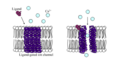 Ligand-gated ion channel
 -
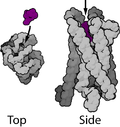 Mu-opioid receptor (GPCR)


.png)
