Neptune: Difference between revisions
CSV import |
CSV import |
||
| Line 21: | Line 21: | ||
[[Category:Neptune]] | [[Category:Neptune]] | ||
{{Astronomy-stub}} | {{Astronomy-stub}} | ||
== Neptune gallery == | |||
<gallery> | |||
File:Neptune symbol (bold).svg|Neptune symbol (bold) | |||
File:Neptune monogram (fixed width).svg|Neptune monogram (fixed width) | |||
File:Neptune Voyager2 color calibrated.png|Neptune Voyager 2 color calibrated | |||
File:Neptune symbol (fixed width).svg|Neptune symbol (fixed width) | |||
File:Galileo.arp.300pix.jpg|Galileo | |||
File:Le Verrier colored.jpg|Le Verrier | |||
File:JohannGalle.jpg|Johann Galle | |||
File:John Couch Adams Cornwall.jpg|John Couch Adams Cornwall | |||
File:Deutsches Museum München - 15803973590.jpg|Deutsches Museum München | |||
File:Neptune, Earth size comparison true color.jpg|Neptune, Earth size comparison true color | |||
</gallery> | |||
Latest revision as of 05:03, 3 March 2025
Neptune is the eighth and farthest known planet from the Sun in the Solar System. It is the fourth-largest planet by diameter and the third-largest by mass. Among the gaseous planets in the solar system, Neptune is the most dense. Neptune is 17 times the mass of Earth and is slightly more massive than its near-twin Uranus, which is 15 times the mass of Earth but not as dense. Neptune orbits the Sun once every 164.8 years at an average distance of 30.1 astronomical unit (4.50×10⁹ km). It is named after the Roman god of the sea and has the astronomical symbol ♆, a stylised version of the god Neptune's trident.
History[edit]
Neptune was the first planet found by mathematical prediction rather than by empirical observation. Unexpected changes in the orbit of Uranus led Alexis Bouvard to deduce that its orbit was subject to gravitational perturbation by an unknown planet. Neptune was subsequently observed with a telescope on 23 September 1846 by Johann Gottfried Galle within a degree of the position predicted by Urbain Le Verrier. Its largest moon, Triton, was discovered shortly thereafter, though none of the planet's remaining known 13 moons were located telescopically until the 20th century.
Physical characteristics[edit]
Neptune's atmosphere is primarily composed of hydrogen and helium, with traces of methane that account for the planet's blue appearance. Neptune's weather is characterised by extremely dynamic storm systems, with winds reaching speeds of almost 600 m/s—nearly supersonic flow. More so than on any other large planet in the Solar System, Neptune's weather is significantly driven by the planet's internal heat.
Moons[edit]
Neptune has 14 known moons. Triton, the largest, accounts for more than 99.5% of all the mass orbiting the planet. Triton is the only moon in the Solar System known to have a retrograde orbit, which is an orbit in the opposite direction to its planet's rotation. Since no similar-sized moon exists in such an orbit, Triton was probably a dwarf planet caught by Neptune's gravity.
Exploration[edit]
The exploration of Neptune has only been conducted by one spacecraft, as of 2021, Voyager 2 by NASA. The spacecraft's closest approach to the planet occurred on 25 August 1989. Voyager 2 studied the structure and composition of Neptune's atmosphere and magnetic field, including its rings and moons.

Neptune gallery[edit]
-
 Neptune symbol (bold)
 -
 Neptune monogram (fixed width)
 -
 Neptune Voyager 2 color calibrated
 -
 Neptune symbol (fixed width)
 -
 Galileo
 -
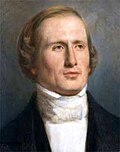 Le Verrier
 -
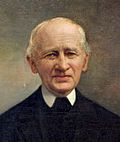 Johann Galle
 -
 John Couch Adams Cornwall
 -
 Deutsches Museum München
 -
 Neptune, Earth size comparison true color
.svg)
.svg)

.svg)


