Acids in wine: Difference between revisions
CSV import |
CSV import |
||
| Line 30: | Line 30: | ||
[[Category:Food chemistry]] | [[Category:Food chemistry]] | ||
[[Category:Acids]] | [[Category:Acids]] | ||
== Acids_in_wine == | |||
<gallery> | |||
File:Wine_grape_diagram_en.svg|Wine grape diagram | |||
File:HomemadeTartaric.jpg|Homemade Tartaric | |||
File:Riesling_Kabinett_1975_in_glass.jpg|Riesling Kabinett 1975 in glass | |||
File:Oak_chips_in_chardonnay.jpg|Oak chips in chardonnay | |||
File:Geranium_E19.jpg|Geranium | |||
File:Crop_carmenere_close_up.JPG|Carmenere close up | |||
</gallery> | |||
Latest revision as of 00:58, 27 February 2025
Acids in wine are an essential component in both winemaking and the finished product of wine. They are present in both grapes and wine, having direct influences on the color, balance and taste of the wine as well as the growth and vitality of yeast during fermentation and protecting the wine from bacteria. The measure of the amount of acidity in wine is known as the "titratable acidity" or "total acidity", which refers to the test that yields the total of all acids present, while strength of acidity is measured according to pH, with most wines having a pH between 2.9 and 3.9. Generally, the lower the pH, the higher the acidity in the wine. However, there is no direct connection between total acidity and pH (it is possible to find wines with a high pH for wine and high acidity). In wine tasting, the term "acidity" refers to the fresh, tart and sour attributes of the wine.
Types of acid[edit]
The most common acids found in wine are tartaric acid, malic acid, and citric acid. These acids are found in the grape and are natural products of the grapevine.
Tartaric acid[edit]
Tartaric acid is, from a winemaking perspective, the most important in wine due to the prominent role it plays in maintaining the chemical stability of the wine and its color and finally in influencing the taste of the finished wine.
Malic acid[edit]
Malic acid, along with tartaric acid, is one of the principal organic acids found in wine grapes. It is found in nearly every fruit and berry plant, but is most often associated with green (especially sour) apples. Its name comes from the Latin malus, meaning "apple".
Citric acid[edit]
Citric acid can be added to wines to increase acidity, complement a specific flavor or prevent ferric hazes. It can be added to finished wines to increase acidity and give a "fresh" flavor.
Acidity in winemaking[edit]
The process of making wine is a delicate balance of acidity. Too much acidity in wine can lead to a wine tasting too tart or sour and may be unpalatable. Too little acidity can result in a flat tasting wine that is at risk for spoilage.
See also[edit]

Acids_in_wine[edit]
-
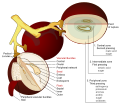 Wine grape diagram
 -
 Homemade Tartaric
 -
 Riesling Kabinett 1975 in glass
 -
 Oak chips in chardonnay
 -
 Geranium
 -
 Carmenere close up


