Pandesal: Difference between revisions
CSV import |
CSV import |
||
| Line 22: | Line 22: | ||
[[Category:Spanish loanwords]] | [[Category:Spanish loanwords]] | ||
{{food-stub}} | {{food-stub}} | ||
<gallery> | |||
File:Pan_de_sal_(Philippines)_02.jpg|Pandesal | |||
File:Pan_de_Sal_(Philippines).jpg|Pandesal | |||
File:Pampanga_Prado_Farm_-_Sausage,_Egg,_Kesong_Puti,_and_Pan_de_Sal.jpg|Pandesal with sausage, egg, and kesong puti | |||
File:Bag_of_pandesal.JPG|Bag of pandesal | |||
File:Pandesaljf1683.JPG|Pandesal | |||
File:Ube_Pandesal_(Filipino_purple_yam_Bread_roll).jpg|Ube Pandesal | |||
File:RNJ_PANDESAL.jpg|Pandesal | |||
File:4921ZMcDonald's_products.jpg|Pandesal | |||
</gallery> | |||
Latest revision as of 11:37, 18 February 2025
Pandesal (also spelled as Pan de Sal) is a popular bread in the Philippines. Its name is Spanish for 'salt bread', although it is typically sweet rather than salty.
History[edit]
The history of Pandesal dates back to the Spanish colonial period in the Philippines. It was introduced by Spanish bakers in the 16th century and has since become a staple in the Filipino diet. The bread was originally plain and round, but over time, it has evolved into a sweet and fluffy bread roll dusted with bread crumbs.
Preparation[edit]
Pandesal is made from simple ingredients: flour, yeast, sugar, salt, water, and shortening. The dough is mixed, allowed to rise, shaped into small rolls, and then baked until golden brown. The bread is typically served warm and can be eaten plain or with a variety of fillings such as cheese, butter, or coconut jam.
Cultural Significance[edit]
Pandesal is a significant part of Filipino culture. It is commonly consumed for breakfast and is often paired with coffee or hot chocolate. In many Filipino households, it is a tradition to buy fresh pandesal from the local bakery early in the morning. The bread is also used in various Filipino dishes and snacks.
Variations[edit]
There are several variations of pandesal across the Philippines. Some bakeries add fillings such as cheese, chocolate, or ube (purple yam) to the dough before baking. Other variations include using different types of flour, such as whole wheat or gluten-free, to cater to different dietary needs.
See Also[edit]

-
 Pandesal
 -
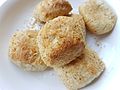 Pandesal
 -
 Pandesal with sausage, egg, and kesong puti
 -
 Bag of pandesal
 -
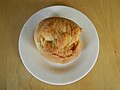 Pandesal
 -
 Ube Pandesal
 -
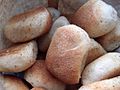 Pandesal
 -
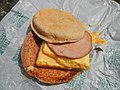 Pandesal
_02.jpg)
.jpg)


.jpg)


