List of Italian cheeses: Difference between revisions
CSV import |
CSV import |
||
| Line 40: | Line 40: | ||
[[Category:Cheeses by country]] | [[Category:Cheeses by country]] | ||
[[Category:Italian cuisine-related lists]] | [[Category:Italian cuisine-related lists]] | ||
<gallery> | |||
File:Pecorino_romano_on_board_cropped.PNG|Pecorino Romano | |||
File:Asiago.jpg|Asiago | |||
File:Bastardo_del_Grappa.jpg|Bastardo del Grappa | |||
File:Cheese_29_bg_051906.jpg|Cheese | |||
File:Bitto.jpg|Bitto | |||
File:Bra_Duro_cheese.jpg|Bra Duro | |||
File:Burrata2.jpg|Burrata | |||
File:Caciocavallo.JPG|Caciocavallo | |||
</gallery> | |||
Latest revision as of 11:19, 25 February 2025
List of Italian Cheeses
Italian cheeses are a significant part of Italian culinary tradition, with hundreds of varieties produced across the country. Each region in Italy has its own unique cheese, reflecting the local customs, traditions, and environment. This list includes some of the most well-known and popular Italian cheeses.
Parmigiano-Reggiano[edit]
Parmigiano-Reggiano, often referred to as Parmesan, is a hard, granular cheese that originated in the Emilia-Romagna and Lombardy regions of Italy. It is named after the producing areas of Parma, Reggio Emilia, Modena, Bologna, and Mantova. Parmigiano-Reggiano is made from raw cow's milk and aged for at least 12 months, with the best varieties aged for 24 months or more.
Mozzarella[edit]
Mozzarella is a traditionally southern Italian cheese made from Italian buffalo's milk by the pasta filata method. It is a fresh cheese, typically consumed the day after it is made. Mozzarella is used in a variety of dishes, including pizza, Caprese salad, and lasagna.
Gorgonzola[edit]
Gorgonzola is a blue-veined cheese, made from unskimmed cow's milk. It can be buttery or firm, crumbly and quite salty, with a 'bite' from its blue veining. Gorgonzola is traditionally produced in the town of the same name in the Lombardy region.
Pecorino Romano[edit]
Pecorino Romano is a hard, salty Italian cheese, often used for grating, made out of sheep's milk (pecora in Italian). It is produced in the region of Lazio and in the Sardinian provinces of Sassari, Cagliari, and Oristano.
Ricotta[edit]
Ricotta is a whey cheese made from sheep, cow, goat, or Italian water buffalo milk whey left over from the production of other cheeses. It is a fresh cheese that is creamy white in appearance, slightly sweet in taste, and contains around 13% fat.
Provolone[edit]
Provolone is an Italian cheese that originated in Southern Italy, where it is still produced in various shapes as in 10 to 15 cm long pear, sausage, or cone shapes. It is a semi-hard cheese with a smooth skin, produced mainly in the Po River Valley regions of Lombardia and Veneto.
Asiago[edit]
Asiago is an Italian cow's milk cheese that can assume different textures, according to its aging, from smooth for the fresh Asiago (Asiago Pressato) to a crumbly texture for the aged cheese (Asiago d'allevo). It is produced in the Veneto and Trentino regions.
Taleggio[edit]
Taleggio is a semi-soft, washed-rind, smear-ripened Italian cheese that is named after Val Taleggio. It's one of the oldest soft cheeses, produced in autumn and winter. During cheese making, the acidic milk is brought to the lab, and kept on the wood shelves in the chambers as well in caves according to tradition.
See also[edit]
References[edit]
<references />
This is a non-exhaustive food and drink related list.

-
 Pecorino Romano
 -
 Asiago
 -
 Bastardo del Grappa
 -
 Cheese
 -
 Bitto
Bitto -
 Bra Duro
 -
 Burrata
 -
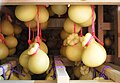 Caciocavallo


