Zaru: Difference between revisions
CSV import |
|||
| (One intermediate revision by the same user not shown) | |||
| Line 25: | Line 25: | ||
{{Japan-cuisine-stub}} | {{Japan-cuisine-stub}} | ||
{{food-stub}} | {{food-stub}} | ||
= Zaru = | |||
<gallery> | |||
File:Zaru.jpg|Zaru | |||
File:Seiro_soba_at_Takasho_in_Nezu,_Tokyo.jpg|Seiro soba at Takasho in Nezu, Tokyo | |||
</gallery> | |||
Latest revision as of 03:21, 17 February 2025
Zaru is a type of Japanese serving dish traditionally used in the presentation and consumption of certain Japanese dishes. The term "zaru" translates to "basket" in English, reflecting the dish's basket-like design.
Design and Use[edit]
Zaru dishes are typically made from bamboo and are woven in a way that allows for ventilation and drainage. This design is particularly useful for dishes that need to be drained of excess liquid before serving, such as soba noodles and tempura.
The most common use of a zaru is in the serving of zaru soba, a popular Japanese dish consisting of cold soba noodles that are typically served with a dipping sauce known as tsuyu. The zaru allows the noodles to be drained of excess water after cooking, which enhances their texture and flavor.
Cultural Significance[edit]
The use of zaru in Japanese cuisine reflects the country's emphasis on presentation and aesthetics in food preparation. The simple, natural design of the zaru complements the minimalist aesthetic often associated with Japanese cuisine.
In addition to its practical uses, the zaru also holds cultural significance in Japan. It is often used in traditional Japanese tea ceremonies, where it serves as a symbol of purity and simplicity.
See Also[edit]


Zaru[edit]
-
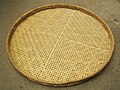 Zaru
Zaru -
 Seiro soba at Takasho in Nezu, Tokyo


