Pusô: Difference between revisions
CSV import Tags: mobile edit mobile web edit |
CSV import Tags: mobile edit mobile web edit |
||
| Line 16: | Line 16: | ||
{{Philippine-cuisine-stub}} | {{Philippine-cuisine-stub}} | ||
{{food-stub}} | {{food-stub}} | ||
<gallery> | |||
File:Puso-_Rice_from_Cebu_City.JPG|Pusô | |||
File:Puso_of_cooked_rice.JPG|Pusô | |||
File:Conching's_Native_Lechon_Manok.jpg|Conching's Native Lechon Manok | |||
File:SattiTamu.jpg|Satti Tamu | |||
File:Puso_and_BBQ_Feast_-_Chicken_Skin,_Pork_Belly,_Chicken_Liver_and_Intestines.jpg|Pusô and BBQ Feast - Chicken Skin, Pork Belly, Chicken Liver and Intestines | |||
File:Organic_packing_rice_cebu_2017_wrapping_of_food.jpg|Organic Packing Rice Cebu 2017 - Wrapping of Food | |||
File:Patupatjf.JPG|Patupat | |||
File:HANGING_RICE.jpg|Hanging Rice | |||
</gallery> | |||
Latest revision as of 11:36, 18 February 2025
Pusô is a traditional Filipino dish made from rice that is wrapped in a woven palm leaf pouch and boiled. It is also known as "hanging rice" due to the way it is often displayed and sold. Pusô is commonly served as a side dish with barbecue or lechon, and is a staple during festive occasions and public celebrations in the Visayas and Mindanao regions of the Philippines.
Etymology[edit]
The term "pusô" is derived from the Cebuano word for "heart", which refers to the heart-like shape of the woven palm leaf pouch. In other regions of the Philippines, it is also known as "patupat" in Pangasinan, "binuclatan" in Bicolano, and "kinalawag" in Hiligaynon.
Preparation[edit]
The preparation of pusô involves two main steps: the weaving of the palm leaf pouch and the cooking of the rice. The pouch is typically woven from young and pliable coconut leaves, although other types of palm leaves can also be used. The rice used is usually ordinary white rice, but glutinous rice can also be used for a sweeter version.
Once the pouch is woven, it is filled with soaked rice and sealed. The pouches are then boiled in water until the rice is cooked. The resulting dish is a compact, diamond-shaped packet of rice that can be eaten on its own or with other dishes.
Cultural Significance[edit]
Pusô is deeply ingrained in Filipino culture, particularly in the Visayas and Mindanao regions. It is a common sight in public markets, roadside stalls, and local eateries. During festive occasions like the Sinulog Festival and Kadayawan Festival, pusô is often served as a communal dish, symbolizing unity and shared heritage.


-
 Pusô
Pusô -
 Pusô
Pusô -
 Conching's Native Lechon Manok
 -
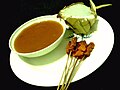 Satti Tamu
 -
 Pusô and BBQ Feast - Chicken Skin, Pork Belly, Chicken Liver and Intestines
 -
 Organic Packing Rice Cebu 2017 - Wrapping of Food
 -
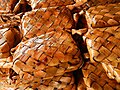 Patupat
 -
 Hanging Rice


