Jeongol: Difference between revisions
CSV import Tags: mobile edit mobile web edit |
CSV import Tags: mobile edit mobile web edit |
||
| Line 22: | Line 22: | ||
{{Korea-food-stub}} | {{Korea-food-stub}} | ||
{{food-stub}} | {{food-stub}} | ||
<gallery> | |||
File:KOCIS_dubu-jeongol,_Tofu_Hot_Pot_(4556778564).jpg|Jeongol | |||
</gallery> | |||
Latest revision as of 22:12, 16 February 2025
Jeongol is a type of traditional Korean cuisine that is similar to a stew or hot pot. It is typically prepared with a variety of ingredients, including meat, seafood, vegetables, and tofu, and is often served in a communal pot for shared eating.
History[edit]
The origins of Jeongol date back to the Joseon Dynasty, when it was a dish enjoyed by the royal court and the nobility. The dish was originally known as josun, which means "pot" in Korean. Over time, the dish evolved and became more accessible to the common people, and its name was changed to Jeongol.
Preparation[edit]
Jeongol is typically prepared by simmering a variety of ingredients in a rich broth. The ingredients can vary widely, but commonly include beef, pork, chicken, seafood, mushrooms, tofu, and various vegetables. The broth is typically made from soy sauce, garlic, sesame oil, and gochujang (Korean chili paste). The dish is often served with rice and kimchi on the side.
Varieties[edit]
There are many different varieties of Jeongol, each with its own unique combination of ingredients. Some of the most popular varieties include:
- Bulgogi Jeongol: This variety is made with thinly sliced beef marinated in a sweet and savory sauce.
- Haemul Jeongol: This seafood-based variety includes a variety of seafood such as clams, shrimp, and squid.
- Mushroom Jeongol: This vegetarian-friendly variety is made with a variety of mushrooms and vegetables.
Cultural Significance[edit]
Jeongol is often enjoyed as a communal meal, with the pot placed in the center of the table for everyone to share. It is a popular choice for family gatherings and celebrations, and is also commonly served in restaurants and street food stalls in Korea.

-
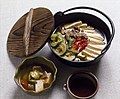 Jeongol
.jpg)
