Ginanggang: Difference between revisions
CSV import Tags: mobile edit mobile web edit |
CSV import Tags: mobile edit mobile web edit |
||
| Line 22: | Line 22: | ||
{{Philippine-cuisine-stub}} | {{Philippine-cuisine-stub}} | ||
{{food-stub}} | {{food-stub}} | ||
<gallery> | |||
File:Ginangang,_grilled_bananas.jpg|Ginanggang | |||
File:Ginanggang_grilled_banana.jpg|Ginanggang | |||
</gallery> | |||
Latest revision as of 00:55, 18 February 2025
Ginanggang is a popular Filipino street food made from bananas, specifically the saba variety. The term "ginanggang" is derived from the Cebuano word "ganggang" which means "to grill".
Preparation[edit]
The preparation of ginanggang involves skewering a peeled saba banana, grilling it over charcoal until it becomes golden brown, and then brushing it with margarine and sprinkling it with sugar. The result is a sweet and savory snack that is both filling and satisfying.
Cultural Significance[edit]
Ginanggang is a common sight in the streets of the Philippines, particularly in the Visayas and Mindanao regions. It is often sold by street vendors, alongside other popular Filipino street foods such as isaw, kwek-kwek, and balut.
In addition to being a popular street food, ginanggang also holds cultural significance in the Philippines. It is often served during fiestas and other local celebrations, and is a favorite snack among Filipinos of all ages.
Variations[edit]
While the traditional ginanggang is made with saba bananas, there are also variations of this dish that use other types of bananas or even other fruits. For example, some vendors offer ginanggang made with plantains or sweet potatoes.
See Also[edit]


-
 Ginanggang
 -
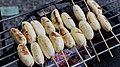 Ginanggang


