Skewness: Difference between revisions
CSV import |
CSV import |
||
| Line 38: | Line 38: | ||
{{stub}} | {{stub}} | ||
<gallery> | |||
File:SkewedDistribution.png|Skewed Distribution | |||
File:Negative_and_positive_skew_diagrams_(English).svg|Negative and Positive Skew Diagrams | |||
File:Asymmetric_Distribution_with_Zero_Skewness.jpg|Asymmetric Distribution with Zero Skewness | |||
File:Relationship_between_mean_and_median_under_different_skewness.png|Relationship between Mean and Median under Different Skewness | |||
File:Positive_skewness_with_mean_less_than_median.png|Positive Skewness with Mean Less than Median | |||
File:Comparison_mean_median_mode.svg|Comparison of Mean, Median, and Mode | |||
</gallery> | |||
Latest revision as of 11:29, 18 February 2025
Skewness is a measure in statistics used to describe the asymmetry of a probability distribution about its mean. It quantifies the extent and direction of skew (departure from horizontal symmetry). The skewness value can be positive, zero, negative, or undefined.
Definition[edit]
For a univariate data set X1, X2, ..., Xn, the formula for skewness is:
- g1 = μ3 / μ2^(3/2)
where μ3 is the third central moment and μ2 is the second central moment (the variance). If the data are standardized, the formula simplifies to:
- G1 = g1 * sqrt(n(n-1)) / (n-2)
Interpretation[edit]
Positive skewness indicates that the tail on the right side of the probability density function is longer or fatter than the left side. Negative skewness indicates that the tail on the left side is longer or fatter than the right side. If the skewness is zero, the data are perfectly symmetrical, although it is quite unlikely for real-world data.
Types of Skewness[edit]
There are two types of skewness: positive skewness and negative skewness.
- Positive Skewness: This occurs when the tail on the right side of the distribution is longer or fatter. The mean and median will be greater than the mode.
- Negative Skewness: This occurs when the tail on the left side of the distribution is longer or fatter. The mean and median will be less than the mode.
Applications[edit]
Skewness is used in many areas, including probability theory, statistics, finance, and economics. It is used to make decisions based on the skewness of the distribution of a set of data.
See also[edit]
References[edit]
<references />
 | |
|---|---|
 |
 |
-
 Skewed Distribution
 -
 Negative and Positive Skew Diagrams
 -
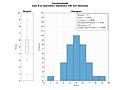 Asymmetric Distribution with Zero Skewness
 -
 Relationship between Mean and Median under Different Skewness
 -
Positive Skewness with Mean Less than Median
-
Comparison of Mean, Median, and Mode

.svg)


