Ultracentrifuge: Difference between revisions
CSV import |
CSV import |
||
| (One intermediate revision by the same user not shown) | |||
| Line 1: | Line 1: | ||
''' | == Ultracentrifuge == | ||
An '''ultracentrifuge''' is a type of [[centrifuge]] that operates at very high speeds, capable of generating accelerations as high as 1,000,000 g (9,800 km/s_). Ultracentrifuges are used in a variety of scientific fields, including [[molecular biology]], [[biochemistry]], and [[polymer science]], to separate particles of different densities or to purify molecules such as [[proteins]], [[nucleic acids]], and [[viruses]]. | |||
[[File:Beckman-Coulter_ultracentrifuge_XL-100K_-01.jpg|thumb|A Beckman-Coulter ultracentrifuge XL-100K]] | |||
== History == | == History == | ||
== | The concept of the ultracentrifuge was first developed by [[Theodor Svedberg]] in the early 20th century. Svedberg's work on the ultracentrifuge earned him the [[Nobel Prize in Chemistry]] in 1926 for his research on [[colloids]] and [[macromolecules]]. The first practical ultracentrifuge was built in the 1920s, and since then, the technology has evolved significantly. | ||
Ultracentrifuges are | |||
== Types of Ultracentrifuges == | |||
Ultracentrifuges are generally classified into two main types: analytical and preparative. | |||
=== Analytical Ultracentrifuge === | |||
The analytical ultracentrifuge is used to study the properties of macromolecules. It allows scientists to determine the [[molecular weight]], [[sedimentation coefficient]], and [[diffusion coefficient]] of particles. The analytical ultracentrifuge is equipped with optical systems that enable the observation of the sample during centrifugation. | |||
=== Preparative Ultracentrifuge === | |||
The preparative ultracentrifuge is used to separate and purify particles based on their size, shape, and density. It is commonly used in the purification of [[biological macromolecules]] and [[subcellular organelles]]. | |||
== Applications == | == Applications == | ||
== | Ultracentrifuges are essential tools in the field of [[biotechnology]] and [[biomedical research]]. They are used in the isolation of [[DNA]], [[RNA]], and [[proteins]] for various applications, including [[genetic engineering]] and [[drug development]]. In [[virology]], ultracentrifuges are used to purify [[viruses]] and [[viral particles]]. | ||
== Operation == | |||
Ultracentrifuges operate by spinning samples at very high speeds, creating a strong [[centrifugal force]] that causes particles to sediment at different rates based on their size and density. The rotor, which holds the samples, is a critical component of the ultracentrifuge and must be carefully balanced to prevent damage to the machine. | |||
[[File:Beckman_model_e_hm50tr96s.tiff|thumb|A Beckman Model E ultracentrifuge]] | |||
== Safety Considerations == | |||
Due to the high speeds and forces involved, ultracentrifuges require careful handling and maintenance. Proper training and adherence to safety protocols are essential to prevent accidents and equipment damage. | |||
== Related Pages == | |||
* [[Centrifuge]] | * [[Centrifuge]] | ||
* [[Sedimentation]] | |||
* [[Molecular biology]] | |||
* [[Biochemistry]] | * [[Biochemistry]] | ||
== References == | |||
* Svedberg, T. (1926). "The Ultracentrifuge". Nobel Lecture. | |||
* Beckman Coulter, Inc. "Ultracentrifuges: A Guide to Operation and Safety". | |||
{{Authority control}} | |||
[[Category:Laboratory equipment]] | [[Category:Laboratory equipment]] | ||
[[Category: | [[Category:Biochemistry methods]] | ||
[[Category:Molecular biology techniques]] | |||
==Ultracentrifuge== | |||
<gallery> | |||
File:Beckman-Coulter_ultracentrifuge_XL-100K_-01.jpg|Beckman Coulter Ultracentrifuge XL-100K | |||
File:Beckman_model_e_hm50tr96s.tiff|Beckman Model E Ultracentrifuge | |||
</gallery> | |||
Latest revision as of 02:11, 18 February 2025
Ultracentrifuge[edit]
An ultracentrifuge is a type of centrifuge that operates at very high speeds, capable of generating accelerations as high as 1,000,000 g (9,800 km/s_). Ultracentrifuges are used in a variety of scientific fields, including molecular biology, biochemistry, and polymer science, to separate particles of different densities or to purify molecules such as proteins, nucleic acids, and viruses.

History[edit]
The concept of the ultracentrifuge was first developed by Theodor Svedberg in the early 20th century. Svedberg's work on the ultracentrifuge earned him the Nobel Prize in Chemistry in 1926 for his research on colloids and macromolecules. The first practical ultracentrifuge was built in the 1920s, and since then, the technology has evolved significantly.
Types of Ultracentrifuges[edit]
Ultracentrifuges are generally classified into two main types: analytical and preparative.
Analytical Ultracentrifuge[edit]
The analytical ultracentrifuge is used to study the properties of macromolecules. It allows scientists to determine the molecular weight, sedimentation coefficient, and diffusion coefficient of particles. The analytical ultracentrifuge is equipped with optical systems that enable the observation of the sample during centrifugation.
Preparative Ultracentrifuge[edit]
The preparative ultracentrifuge is used to separate and purify particles based on their size, shape, and density. It is commonly used in the purification of biological macromolecules and subcellular organelles.
Applications[edit]
Ultracentrifuges are essential tools in the field of biotechnology and biomedical research. They are used in the isolation of DNA, RNA, and proteins for various applications, including genetic engineering and drug development. In virology, ultracentrifuges are used to purify viruses and viral particles.
Operation[edit]
Ultracentrifuges operate by spinning samples at very high speeds, creating a strong centrifugal force that causes particles to sediment at different rates based on their size and density. The rotor, which holds the samples, is a critical component of the ultracentrifuge and must be carefully balanced to prevent damage to the machine.

Safety Considerations[edit]
Due to the high speeds and forces involved, ultracentrifuges require careful handling and maintenance. Proper training and adherence to safety protocols are essential to prevent accidents and equipment damage.
Related Pages[edit]
References[edit]
- Svedberg, T. (1926). "The Ultracentrifuge". Nobel Lecture.
- Beckman Coulter, Inc. "Ultracentrifuges: A Guide to Operation and Safety".
Ultracentrifuge[edit]
-
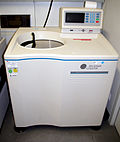 Beckman Coulter Ultracentrifuge XL-100K
 -
 Beckman Model E Ultracentrifuge
