Nonviolence: Difference between revisions
CSV import |
CSV import |
||
| Line 28: | Line 28: | ||
{{stub}} | {{stub}} | ||
<gallery> | |||
File:Portrait_Gandhi.jpg|Mahatma Gandhi | |||
File:Bundesarchiv_B_145_Bild-F065187-0014,_Bonn,_Pressekonferenz_der_Grünen,_Bundestagswahl.jpg|Press conference of the Greens, Bundestag election | |||
File:Gandhi_at_Dandi_5_April_1930.jpg|Gandhi at Dandi, 5 April 1930 | |||
File:Semai_-_remaja.jpg|Nonviolence | |||
File:Ahimsa_Jainism_Gradient.jpg|Ahimsa in Jainism | |||
File:Martin_Luther_King_-_March_on_Washington.jpg|Martin Luther King Jr. at the March on Washington | |||
File:Bloody_Sunday-officers_await_demonstrators.jpeg|Bloody Sunday, officers await demonstrators | |||
</gallery> | |||
Latest revision as of 10:55, 18 February 2025
Nonviolence is a philosophy and strategy for social change that rejects the use of violence. As such, it is often associated with the advancement of peace and social justice. Nonviolence can refer to both a moral philosophy and a tactical strategy. As a philosophy, it asserts that violence is unnecessary and counterproductive, and that meaningful change can be achieved without harm or destruction. As a strategy, it involves various methods for dealing with social injustice, including protest, persuasion, noncooperation, and nonviolent intervention.
Philosophy[edit]
The philosophy of nonviolence has roots in various religious and ethical traditions. In Buddhism, for example, the first precept is to abstain from taking life. In Christianity, the Sermon on the Mount contains several teachings that have been interpreted as endorsing nonviolence, such as "turn the other cheek" and "love your enemies". In Hinduism, the concept of ahimsa (non-harming) is a central tenet.
Strategy[edit]
As a strategy, nonviolence can take many forms. These include:
- Protest: Demonstrations, marches, and other forms of public display to raise awareness and pressure authorities.
- Persuasion: Efforts to change minds through dialogue, education, and advocacy.
- Noncooperation: Refusal to comply with unjust laws or policies, often through civil disobedience.
- Nonviolent intervention: Direct action to prevent or stop an injustice, such as a sit-in or blockade.
History[edit]
Nonviolence has been used as a strategy by many social movements throughout history. Some notable examples include the Indian independence movement led by Mahatma Gandhi, the American civil rights movement led by Martin Luther King Jr., and the anti-apartheid movement in South Africa.
See also[edit]
References[edit]
<references />
 | This medical article is a stub. You can help WikiMD by expanding the page. |
-
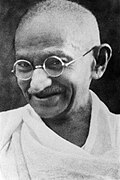 Mahatma Gandhi
 -
 Press conference of the Greens, Bundestag election
 -
 Gandhi at Dandi, 5 April 1930
 -
 Nonviolence
 -
 Ahimsa in Jainism
 -
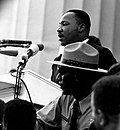 Martin Luther King Jr. at the March on Washington
 -
 Bloody Sunday, officers await demonstrators


