Eclipse: Difference between revisions
CSV import Tags: mobile edit mobile web edit |
CSV import |
||
| Line 35: | Line 35: | ||
{{stub}} | {{stub}} | ||
{{dictionary-stub1}} | {{dictionary-stub1}} | ||
<gallery> | |||
File:Solar_eclipse_1999_4.jpg|Solar eclipse 1999 | |||
File:ISS-52_Eclipse_2017_Umbra_Viewed_from_Space_(1).jpg|Eclipse 2017 Umbra Viewed from Space | |||
File:Umbra01.svg|Umbra | |||
File:Solar_eclipse_types.svg|Solar eclipse types | |||
File:Eclipse_vs_new_or_full_moons,_annotated.svg|Eclipse vs new or full moons, annotated | |||
File:Lunar_eclipse_diagram-en.svg|Lunar eclipse diagram | |||
File:Total_Solar_Eclipse_-_April_8,_2024_-_Mazatlan_Mexico_-_Ten_Minute_Time_Lapse_v2_1080p.webm|Total Solar Eclipse - April 8, 2024 - Mazatlan Mexico - Ten Minute Time Lapse | |||
File:2008-08-01_Solar_eclipse_progression_with_timestamps.jpg|Solar eclipse progression with timestamps | |||
File:Solar_eclipse_visualisation.svg|Solar eclipse visualisation | |||
File:Geometry_of_a_Total_Solar_Eclipse.svg|Geometry of a Total Solar Eclipse | |||
File:Earth_Eclipses_Sun-ap12-s80-37406.jpg|Earth Eclipses Sun | |||
File:Saturn_eclipse.jpg|Saturn eclipse | |||
</gallery> | |||
Latest revision as of 21:16, 23 February 2025
Eclipse is a term used in astronomy to describe the event when an astronomical object is temporarily obscured, either by passing into the shadow of another body or by having another body pass between it and the viewer. This can be the result of a planet (including Earth) passing through the shadow of another planet, or a planet's moon passing in front of the planet.
Types of Eclipses[edit]
There are four types of eclipses: solar eclipse, lunar eclipse, appulse, and occultation.
Solar Eclipse[edit]
A solar eclipse occurs when the Moon passes between Earth and the Sun, thereby totally or partially obscuring Earth's view of the Sun.
Lunar Eclipse[edit]
A lunar eclipse occurs when the Moon passes directly behind Earth and into its shadow. This can occur only when the Sun, Earth, and Moon are exactly or very closely aligned, with Earth between the other two.
Appulse[edit]
An appulse is an astronomical term that refers to the closest approach of one celestial object to another, as viewed from a third body.
Occultation[edit]
An occultation is an event that occurs when one object is hidden by another object that passes between it and the observer.
Historical Significance[edit]
Eclipses have been of significant importance in the history of science, particularly in the development of astronomy. They have been used to test and confirm scientific theories, such as Einstein's theory of general relativity.
Safety[edit]
Viewing a solar eclipse without suitable eye protection can lead to eye damage or even blindness. Special eclipse glasses or handheld solar viewers are required to safely observe a solar eclipse.
See Also[edit]
 | |
|---|---|
 |
 |
-
 Solar eclipse 1999
 -
 Eclipse 2017 Umbra Viewed from Space
 -
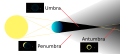 Umbra
Umbra -
 Solar eclipse types
 -
 Eclipse vs new or full moons, annotated
 -
 Lunar eclipse diagram
 -
 Total Solar Eclipse - April 8, 2024 - Mazatlan Mexico - Ten Minute Time Lapse
 -
 Solar eclipse progression with timestamps
 -
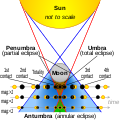 Solar eclipse visualisation
 -
 Geometry of a Total Solar Eclipse
 -
 Earth Eclipses Sun
 -
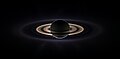 Saturn eclipse

.jpg)


