Dihydroorotase: Difference between revisions
CSV import |
CSV import |
||
| (2 intermediate revisions by the same user not shown) | |||
| Line 1: | Line 1: | ||
Dihydroorotase is an enzyme that plays a crucial role in the | '''Dihydroorotase''' is an [[enzyme]] that plays a crucial role in the [[de novo synthesis of pyrimidine nucleotides]]. It catalyzes the reversible cyclization of [[carbamoyl aspartate]] to [[dihydroorotate]], an essential step in the [[pyrimidine biosynthesis pathway]]. | ||
== Structure | ==Structure== | ||
Dihydroorotase is a | Dihydroorotase is a [[metalloenzyme]] that typically contains a [[zinc]] ion at its active site. The enzyme is composed of a single polypeptide chain that folds into a characteristic [[TIM barrel]] structure. The active site is located at the C-terminal end of the barrel, where the zinc ion is coordinated by histidine and aspartate residues. | ||
The | ==Function== | ||
The primary function of dihydroorotase is to catalyze the conversion of [[N-carbamoyl-L-aspartate]] to [[L-dihydroorotate]]. This reaction is part of the [[pyrimidine biosynthesis]] pathway, which is essential for the production of [[nucleotides]] such as [[cytosine]], [[thymine]], and [[uracil]]. These nucleotides are critical components of [[DNA]] and [[RNA]], making dihydroorotase vital for [[cellular replication]] and [[gene expression]]. | |||
== | ==Mechanism== | ||
Dihydroorotase operates through a mechanism that involves the coordination of the substrate to the zinc ion, facilitating the cyclization reaction. The enzyme stabilizes the transition state and lowers the activation energy required for the reaction. The zinc ion plays a crucial role in polarizing the carbonyl group of the substrate, making it more susceptible to nucleophilic attack. | |||
==Regulation== | |||
The activity of dihydroorotase is regulated by the availability of its substrates and the presence of [[feedback inhibitors]] from downstream products in the pyrimidine biosynthesis pathway. Additionally, the enzyme can be regulated through [[post-translational modifications]] such as phosphorylation. | |||
== Clinical Significance == | ==Clinical Significance== | ||
Deficiencies or malfunctions in dihydroorotase can lead to disruptions in pyrimidine metabolism, which may result in metabolic disorders. Understanding the function and regulation of dihydroorotase is important for developing therapeutic strategies for conditions related to [[nucleotide imbalance]]. | |||
Dihydroorotase | ==Related Enzymes== | ||
Dihydroorotase is part of a larger family of enzymes involved in pyrimidine metabolism, including [[carbamoyl phosphate synthetase]], [[aspartate transcarbamoylase]], and [[dihydroorotate dehydrogenase]]. These enzymes work in concert to ensure the proper synthesis and regulation of pyrimidine nucleotides. | |||
== | ==See Also== | ||
* [[Pyrimidine metabolism]] | |||
* [[Nucleotide synthesis]] | |||
* [[Enzyme catalysis]] | |||
== | ==External Links== | ||
* [ | * [Dihydroorotase at the US National Library of Medicine Medical Subject Headings (MeSH)] | ||
{{Enzymes}} | |||
{{Pyrimidine metabolism}} | |||
[[Category:EC 3.5.2]] | |||
[[Category:Metalloenzymes]] | |||
[[Category:Pyrimidine metabolism]] | |||
[[Category:Enzymes]] | [[Category:Enzymes]] | ||
<gallery> | |||
File:4by3.jpg|4by3 | |||
</gallery> | |||
Latest revision as of 00:36, 27 February 2025
Dihydroorotase is an enzyme that plays a crucial role in the de novo synthesis of pyrimidine nucleotides. It catalyzes the reversible cyclization of carbamoyl aspartate to dihydroorotate, an essential step in the pyrimidine biosynthesis pathway.
Structure[edit]
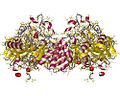
Dihydroorotase is a metalloenzyme that typically contains a zinc ion at its active site. The enzyme is composed of a single polypeptide chain that folds into a characteristic TIM barrel structure. The active site is located at the C-terminal end of the barrel, where the zinc ion is coordinated by histidine and aspartate residues.
Function[edit]
The primary function of dihydroorotase is to catalyze the conversion of N-carbamoyl-L-aspartate to L-dihydroorotate. This reaction is part of the pyrimidine biosynthesis pathway, which is essential for the production of nucleotides such as cytosine, thymine, and uracil. These nucleotides are critical components of DNA and RNA, making dihydroorotase vital for cellular replication and gene expression.
Mechanism[edit]
Dihydroorotase operates through a mechanism that involves the coordination of the substrate to the zinc ion, facilitating the cyclization reaction. The enzyme stabilizes the transition state and lowers the activation energy required for the reaction. The zinc ion plays a crucial role in polarizing the carbonyl group of the substrate, making it more susceptible to nucleophilic attack.
Regulation[edit]
The activity of dihydroorotase is regulated by the availability of its substrates and the presence of feedback inhibitors from downstream products in the pyrimidine biosynthesis pathway. Additionally, the enzyme can be regulated through post-translational modifications such as phosphorylation.
Clinical Significance[edit]
Deficiencies or malfunctions in dihydroorotase can lead to disruptions in pyrimidine metabolism, which may result in metabolic disorders. Understanding the function and regulation of dihydroorotase is important for developing therapeutic strategies for conditions related to nucleotide imbalance.
Related Enzymes[edit]
Dihydroorotase is part of a larger family of enzymes involved in pyrimidine metabolism, including carbamoyl phosphate synthetase, aspartate transcarbamoylase, and dihydroorotate dehydrogenase. These enzymes work in concert to ensure the proper synthesis and regulation of pyrimidine nucleotides.
See Also[edit]
External Links[edit]
- [Dihydroorotase at the US National Library of Medicine Medical Subject Headings (MeSH)]
| Enzymes | ||||||||||
|---|---|---|---|---|---|---|---|---|---|---|
|
Template:Pyrimidine metabolism
-
 4by3
4by3

