Urea: Difference between revisions
CSV import |
No edit summary |
||
| (One intermediate revision by the same user not shown) | |||
| Line 1: | Line 1: | ||
{{short description|Chemical compound}} | {{short description|Chemical compound}} | ||
[[File:CSD_CIF_WITQEV.jpg|thumb|right|Molecular structure of urea]] | [[File:CSD_CIF_WITQEV.jpg|thumb|right|Molecular structure of urea]] | ||
[[File:Urea process plant UFFL 01.jpg|thumb|right|Urea process plant]] | [[File:Urea process plant UFFL 01.jpg|thumb|right|Urea process plant]] | ||
| Line 7: | Line 5: | ||
'''Urea''', also known as '''carbamide''', is an organic compound with the chemical formula (NH_)_CO. It is a colorless, odorless solid, highly soluble in water, and practically non-toxic. Urea is widely used in fertilizers as a source of nitrogen and is an important raw material for the chemical industry. | '''Urea''', also known as '''carbamide''', is an organic compound with the chemical formula (NH_)_CO. It is a colorless, odorless solid, highly soluble in water, and practically non-toxic. Urea is widely used in fertilizers as a source of nitrogen and is an important raw material for the chemical industry. | ||
==Production== | ==Production== | ||
| Line 27: | Line 22: | ||
* [[Fertilizer]] | * [[Fertilizer]] | ||
* [[Organic chemistry]] | * [[Organic chemistry]] | ||
[[Category:Organic compounds]] | [[Category:Organic compounds]] | ||
[[Category:Fertilizers]] | [[Category:Fertilizers]] | ||
[[Category:Chemical processes]] | [[Category:Chemical processes]] | ||
Latest revision as of 04:22, 29 March 2025
Chemical compound


Urea, also known as carbamide, is an organic compound with the chemical formula (NH_)_CO. It is a colorless, odorless solid, highly soluble in water, and practically non-toxic. Urea is widely used in fertilizers as a source of nitrogen and is an important raw material for the chemical industry.
Production[edit]
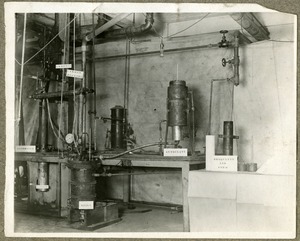
Urea is produced commercially from ammonia and carbon dioxide in a process known as the Bosch-Meiser urea process. This process involves the reaction of ammonia with carbon dioxide at high temperature and pressure to form ammonium carbamate, which is then dehydrated to form urea.
Uses[edit]
Urea is primarily used as a fertilizer, providing a readily available source of nitrogen to plants. It is also used in the manufacture of plastics, adhesives, and resins. In the medical field, urea is used in topical creams to treat skin conditions such as psoriasis and eczema.
Biological role[edit]
In the human body, urea is a waste product formed in the liver through the urea cycle, which converts toxic ammonia into urea for excretion in urine. This process is crucial for the removal of excess nitrogen from the body.
Environmental impact[edit]
The use of urea as a fertilizer can lead to environmental issues such as eutrophication and the release of nitrous oxide, a potent greenhouse gas. Proper management and application techniques are essential to minimize these impacts.
