Venus: Difference between revisions
CSV import Tags: mobile edit mobile web edit |
No edit summary |
||
| (One intermediate revision by the same user not shown) | |||
| Line 1: | Line 1: | ||
[[File:Venus_2_Approach_Image.jpg|thumb|right|Approach image of Venus]] | [[File:Venus_2_Approach_Image.jpg|thumb|right|Approach image of Venus]] | ||
[[File:Venus_symbol_(bold).svg|Symbol of Venus|thumb|left]] | |||
[[File:Terrestrial_planet_size_comp_2024.png|Comparison of terrestrial planets|thumb|right]] | |||
[[File:2438_pioneer_venus_map_of_venus.jpg|Map of Venus from Pioneer Venus|thumb|left]] | |||
[[File:Venus_-_December_23_2016.png|Venus as seen in December 2016|thumb|right]] | |||
[[File:Solar_system_orrery_inner_planets.gif|Orrery of inner planets|thumb|left]] | |||
[[File:Venus_pentagram.png|Pentagram of Venus|thumb|right]] | |||
'''Venus''' is the second planet from the [[Sun]] and is named after the Roman goddess of love and beauty. As the brightest natural object in the night sky after the [[Moon]], Venus can cast shadows and is often visible to the naked eye in broad daylight. Venus lies within [[Earth]]'s orbit, and so never appears to venture far from the Sun, either setting in the west just after dusk or rising in the east a bit before dawn. Venus orbits the Sun every 224.7 Earth days. With a rotation period of 243 Earth days, it takes longer to rotate about its axis than any other planet in the [[Solar System]] and does so in the opposite direction to most of the other planets. | '''Venus''' is the second planet from the [[Sun]] and is named after the Roman goddess of love and beauty. As the brightest natural object in the night sky after the [[Moon]], Venus can cast shadows and is often visible to the naked eye in broad daylight. Venus lies within [[Earth]]'s orbit, and so never appears to venture far from the Sun, either setting in the west just after dusk or rising in the east a bit before dawn. Venus orbits the Sun every 224.7 Earth days. With a rotation period of 243 Earth days, it takes longer to rotate about its axis than any other planet in the [[Solar System]] and does so in the opposite direction to most of the other planets. | ||
| Line 27: | Line 30: | ||
== Exploration == | == Exploration == | ||
Venus has been explored by several spacecraft, including the Soviet Venera series, which provided the first images of the surface, and NASA's Magellan, which mapped the surface with radar. The European Space Agency's Venus Express orbited the planet from 2006 to 2014, studying its atmosphere and surface. | Venus has been explored by several spacecraft, including the Soviet Venera series, which provided the first images of the surface, and NASA's Magellan, which mapped the surface with radar. The European Space Agency's Venus Express orbited the planet from 2006 to 2014, studying its atmosphere and surface. | ||
== Gallery == | == Gallery == | ||
<gallery> | <gallery> | ||
File:Venus-pacific-levelled.jpg|Venus over the Pacific | File:Venus-pacific-levelled.jpg|Venus over the Pacific | ||
File:Lunar_Occultation_of_Venus_(NHQ201512070001).jpg|Lunar occultation of Venus | File:Lunar_Occultation_of_Venus_(NHQ201512070001).jpg|Lunar occultation of Venus | ||
| Line 53: | Line 38: | ||
File:Venus_Tablet_of_Ammisaduqa.jpg|Venus Tablet of Ammisaduqa | File:Venus_Tablet_of_Ammisaduqa.jpg|Venus Tablet of Ammisaduqa | ||
File:Dresden_Codex_p09.jpg|Dresden Codex | File:Dresden_Codex_p09.jpg|Dresden Codex | ||
File:Venus_Drawing.jpg|Drawing of Venus | File:Venus_Drawing.jpg|Drawing of Venus | ||
File:Foto_de_Venera_9.png|Image from Venera 9 | File:Foto_de_Venera_9.png|Image from Venera 9 | ||
| Line 61: | Line 45: | ||
File:NASA_Cloud_City_on_Venus.jpg|Concept of a cloud city on Venus | File:NASA_Cloud_City_on_Venus.jpg|Concept of a cloud city on Venus | ||
File:Kudurru_Melishipak_Louvre_Sb23_n02.jpg|Kudurru of Melishipak | File:Kudurru_Melishipak_Louvre_Sb23_n02.jpg|Kudurru of Melishipak | ||
</gallery> | </gallery> | ||
== Related pages == | |||
* [[Terrestrial planet]] | |||
* [[Solar System]] | |||
* [[Atmosphere of Venus]] | |||
* [[Exploration of Venus]] | |||
[[Category:Venus]] | [[Category:Venus]] | ||
[[Category:Terrestrial planets]] | [[Category:Terrestrial planets]] | ||
[[Category:Solar System]] | [[Category:Solar System]] | ||
Latest revision as of 04:07, 29 March 2025

.svg)


Venus is the second planet from the Sun and is named after the Roman goddess of love and beauty. As the brightest natural object in the night sky after the Moon, Venus can cast shadows and is often visible to the naked eye in broad daylight. Venus lies within Earth's orbit, and so never appears to venture far from the Sun, either setting in the west just after dusk or rising in the east a bit before dawn. Venus orbits the Sun every 224.7 Earth days. With a rotation period of 243 Earth days, it takes longer to rotate about its axis than any other planet in the Solar System and does so in the opposite direction to most of the other planets.
Physical characteristics[edit]
Internal structure[edit]

Venus is a terrestrial planet and is sometimes called Earth's "sister planet" because of their similar size, mass, proximity to the Sun, and bulk composition. However, it has a radically different atmosphere and surface conditions. Venus has a central iron core and a rocky mantle, similar to Earth.
Surface[edit]

The surface of Venus is covered with smooth, volcanic plains, with two large highland areas: Ishtar Terra and Aphrodite Terra. The planet's surface is obscured by an opaque layer of highly reflective clouds of sulfuric acid, preventing its surface from being seen from space in visible light.
Atmosphere[edit]
Venus has an extremely dense atmosphere composed mainly of carbon dioxide, with clouds of sulfuric acid droplets. The atmospheric pressure at the planet's surface is about 92 times that of Earth's, and the thick atmosphere traps heat in a runaway version of the greenhouse effect that warms Earth.
Orbit and rotation[edit]
Venus orbits the Sun at an average distance of about 108 million kilometers (about 0.7 AU) and completes an orbit every 224.7 Earth days. Unlike most planets in the Solar System, Venus rotates on its axis in a direction opposite to its orbital motion around the Sun. This means that on Venus, the Sun rises in the west and sets in the east.
Observation[edit]

Venus is the third-brightest natural object in the sky after the Sun and the Moon. It is often visible in the morning or evening sky and is sometimes referred to as the "Morning Star" or "Evening Star." Venus exhibits phases like those of the Moon, which can be observed with a telescope.
Exploration[edit]
Venus has been explored by several spacecraft, including the Soviet Venera series, which provided the first images of the surface, and NASA's Magellan, which mapped the surface with radar. The European Space Agency's Venus Express orbited the planet from 2006 to 2014, studying its atmosphere and surface.
Gallery[edit]
-
 Venus over the Pacific
 -
 Lunar occultation of Venus
 -
 Transit of Venus
 -
 Venus Tablet of Ammisaduqa
 -
 Dresden Codex
 -
 Drawing of Venus
 -
 Image from Venera 9
 -
 Vega balloon mission
 -
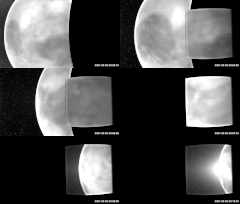 WISPR 4th flyby
 -
 Venus lander topography
 -
 Concept of a cloud city on Venus
 -
 Kudurru of Melishipak

.jpg)
.jpg)


