Khanom thuai: Difference between revisions
CSV import |
No edit summary |
||
| Line 27: | Line 27: | ||
{{Thai-dessert-stub}} | {{Thai-dessert-stub}} | ||
{{food-stub}} | {{food-stub}} | ||
<gallery> | <gallery> | ||
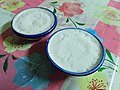
File:Khanom_thuay.jpg|Khanom thuai | File:Khanom_thuay.jpg|Khanom thuai | ||
</gallery> | </gallery> | ||
Latest revision as of 00:21, 17 March 2025
Khanom thuai, also known as tako, is a traditional Thai dessert made from coconut milk, sugar, and flour. It is often served in small, bite-sized portions and is known for its creamy texture and sweet taste.
History[edit]
The origins of khanom thuai can be traced back to the Ayutthaya period in Thailand, where it was a popular dessert among the royal court. The dessert's name, "khanom thuai", is derived from the Thai words "khanom" (dessert) and "thuai" (bowl), referring to the small bowls in which the dessert is traditionally served.
Preparation[edit]
Khanom thuai is made by combining coconut milk, sugar, and flour to create a smooth, creamy mixture. This mixture is then poured into small bowls or cups and steamed until it sets. The dessert is typically topped with a layer of sweetened coconut cream, which adds to its rich flavor.
Cultural Significance[edit]
Khanom thuai is often served during special occasions and festivals in Thailand, such as the Songkran festival and Loy Krathong. It is also a common offering at Buddhist temples, as it is believed to bring good luck and prosperity.
Variations[edit]
There are several variations of khanom thuai, including khanom thuai talai, which includes an additional layer of sweetened coconut cream on top, and khanom thuai nam king, which is flavored with ginger.
See Also[edit]
This article is a Thai dessert-related stub. You can help WikiMD by expanding it!

-
 Khanom thuai

