Group 8 element: Difference between revisions
CSV import |
No edit summary |
||
| (One intermediate revision by the same user not shown) | |||
| Line 34: | Line 34: | ||
[[Category:Chemical elements]] | [[Category:Chemical elements]] | ||
[[Category:Transition metals]] | [[Category:Transition metals]] | ||
<gallery caption="Group 8 element"> | |||
File:Iron electrolytic and 1cm3 cube.jpg|Iron electrolytic and 1cm3 cube | |||
File:Ruthenium a half bar.jpg|Ruthenium a half bar | |||
File:Osmium-crystals 2.jpg|Osmium crystals | |||
</gallery> | |||
Latest revision as of 23:33, 16 March 2025

Group 8 elements are a group of chemical elements in the periodic table consisting of iron (Fe), ruthenium (Ru), osmium (Os), and hassium (Hs). These elements share similar properties and are part of the transition metals category, located in the eighth column of the periodic table.
Properties[edit]
Group 8 elements are characterized by their hard, dense metallic properties. They are typically high in melting points and possess a significant ability to resist corrosion. Each element has a unique set of electron configurations which allows them to form various oxidation states. This is particularly useful in different industrial and chemical applications.
Iron[edit]
Iron is the most common and widely used among the Group 8 elements. It is crucial in the manufacturing of steel and numerous other alloys. Iron's properties such as magnetism, malleability, and conductivity make it an essential material in various sectors including construction, automotive, and electronics.
Ruthenium[edit]
Ruthenium is a rare transition metal that exhibits high resistance to wear and corrosion. It is often used in electrical contacts and as a catalyst in chemical reactions. Ruthenium compounds are also notable for their application in medicine and electronics.
Osmium[edit]
Osmium is the densest naturally occurring element and has a bluish-silver color. It is predominantly used in compounds for its hardness and durability, such as in fountain pen nibs and electrical contacts. Osmium tetroxide is a significant compound used in staining tissues for microscope slides.
Hassium[edit]
Hassium is a synthetic element that is produced in particle accelerators. It has only been created in minute amounts and has no commercial applications due to its extremely short half-life and radioactivity.
Occurrence and Production[edit]
Iron is the fourth most common element in the Earth's crust and is primarily extracted from iron ores such as hematite and magnetite. Ruthenium and osmium are much rarer and are usually obtained as byproducts from nickel and platinum mining.
Hassium, being synthetic, is produced through nuclear reactions involving heavy ions. Its production is limited to a few atoms at a time, making its study and use very restricted.
Applications[edit]
The applications of Group 8 elements are diverse. Iron's role in construction and manufacturing is unparalleled, while ruthenium and osmium's roles in catalysis and industrial hardening processes are critical. Despite their scarcity, the unique properties of ruthenium and osmium make them invaluable in high-tech applications.
See Also[edit]
- Group 8 element
-
 Iron electrolytic and 1cm3 cube
 -
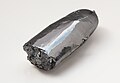 Ruthenium a half bar
 -
 Osmium crystals


