Eriodictyol: Difference between revisions
CSV import Tags: mobile edit mobile web edit |
No edit summary |
||
| (One intermediate revision by the same user not shown) | |||
| Line 24: | Line 24: | ||
{{Chemistry-stub}} | {{Chemistry-stub}} | ||
{{Nutrition-stub}} | {{Nutrition-stub}} | ||
<gallery> | |||
File:Eriodictyol.png|Eriodictyol | |||
File:Eriodictyol_3D_BS.png|Eriodictyol 3D BS | |||
</gallery> | |||
Latest revision as of 20:45, 16 March 2025
Eriodictyol is a bitter-tasting, flavonoid compound that is found in various types of citrus fruits. It is classified as a flavanone, a type of flavonoid, and is known for its potential health benefits.
Chemical Structure[edit]
Eriodictyol has a chemical formula of C15H12O6 and a molecular weight of 288.25 g/mol. It is structurally similar to other flavanones, with a characteristic 15-carbon skeleton that consists of two phenyl groups and a heterocyclic ring.
Sources[edit]
Eriodictyol is primarily found in the peels of citrus fruits such as lemons and oranges. It is also present in herbs like yerba santa and in the leaves of the green tea plant.
Health Benefits[edit]
Eriodictyol has been studied for its potential health benefits. It has been found to have antioxidant properties, which can help to neutralize harmful free radicals in the body. It also has anti-inflammatory effects and may help to reduce inflammation in the body. Some studies have suggested that eriodictyol may have anti-cancer properties, although more research is needed in this area.
Safety and Side Effects[edit]
Eriodictyol is generally considered safe when consumed in amounts typically found in foods. However, high doses may cause side effects such as nausea, vomiting, and diarrhea. As with any supplement, it is recommended to consult with a healthcare provider before starting any new supplement regimen.
See Also[edit]


-
 Eriodictyol
 -
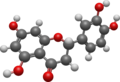 Eriodictyol 3D BS


