Black caiman: Difference between revisions
CSV import |
CSV import |
||
| Line 25: | Line 25: | ||
[[Category:Animals of South America]] | [[Category:Animals of South America]] | ||
{{reptile-stub}} | {{reptile-stub}} | ||
<gallery> | |||
File:Melanosuchus niger (cropped-01).jpg|Melanosuchus niger (cropped-01) | |||
File:Melanosuchus niger in Moscow zoo.jpg|Melanosuchus niger in Moscow zoo | |||
File:black caiman skeleton.jpg|Black caiman skeleton | |||
File:Melanosuchus niger - Flickr - Dick Culbert.jpg|Melanosuchus niger - Flickr - Dick Culbert | |||
File:Blackcaiman leofleck.jpg|Black caiman leofleck | |||
File:Melanosuchus niger RDS Uacari.jpg|Melanosuchus niger RDS Uacari | |||
File:Black Cayman.JPG|Black Cayman | |||
</gallery> | |||
Latest revision as of 05:34, 3 March 2025
Black Caiman (Melanosuchus niger) is a large crocodilian species found in the Amazon rainforest and other freshwater habitats in South America. It is the largest predator in the Amazon ecosystem, preying on a variety of fish, reptiles, birds, and mammals.
Description[edit]
The black caiman is the largest member of the alligator family and the largest predator in the Amazon rainforest. It can reach lengths of up to 6 meters (20 feet) and weights of up to 1,000 kilograms (2,200 pounds). Its body is covered in hard, bony scales that provide protection against predators. The black caiman is named for its dark coloration, which provides camouflage during night hunting.
Distribution and habitat[edit]
The black caiman is found throughout the Amazon rainforest in Brazil, Peru, Ecuador, Bolivia, Colombia, Guyana, French Guiana, Suriname, and Venezuela. It prefers freshwater habitats such as rivers, lakes, and swamps.
Diet[edit]
The diet of the black caiman consists mainly of fish, including piranha and catfish, but it will also eat other reptiles, birds, and mammals. It is an apex predator, meaning it has no natural predators in its environment.
Reproduction[edit]
Female black caimans build nests on the riverbank, where they lay between 30 and 65 eggs. The eggs are incubated for about 90 days. After hatching, the young caimans are cared for by their mother for several months.
Conservation status[edit]
The black caiman is listed as Conservation Dependent on the IUCN Red List. Its population has declined due to hunting for its skin and meat, habitat loss, and pollution.
See also[edit]
.png)
-
 Melanosuchus niger (cropped-01)
 -
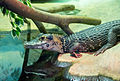 Melanosuchus niger in Moscow zoo
 -
 Black caiman skeleton
 -
 Melanosuchus niger - Flickr - Dick Culbert
 -
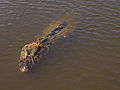 Black caiman leofleck
 -
 Melanosuchus niger RDS Uacari
 -
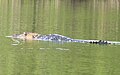 Black Cayman
.jpg)


