RNA world: Difference between revisions
CSV import Tags: mobile edit mobile web edit |
CSV import Tags: mobile edit mobile web edit |
||
| Line 34: | Line 34: | ||
{{biology-stub}} | {{biology-stub}} | ||
{{medicine-stub}} | {{medicine-stub}} | ||
== RNA world gallery == | |||
<gallery> | |||
File:Difference DNA RNA-EN.svg|Difference DNA RNA | |||
File:Ribonucleic acid chemical structure.svg|Ribonucleic acid chemical structure | |||
File:Etls-2019-0024c.01.png|Etls-2019-0024c.01 | |||
</gallery> | |||
Latest revision as of 05:23, 3 March 2025
RNA World is a scientific hypothesis that proposes RNA (ribonucleic acid) played a crucial role in the prebiotic conditions that led to the origin of life on Earth. This hypothesis suggests that before the evolution of DNA (deoxyribonucleic acid) and proteins, life was based on RNA molecules. The RNA World hypothesis posits that RNA was capable of both storing genetic information and catalyzing chemical reactions, making it a plausible precursor to the current DNA/RNA/protein world.
Overview[edit]
The concept of the RNA World is grounded in the discovery that RNA can act as both a repository of genetic information and as a catalyst for specific biochemical reactions. This dual function supports the idea that RNA could have supported prebiotic self-replicating systems. The hypothesis gained significant attention in the 1980s following the discovery of ribozymes, RNA molecules with catalytic capabilities, which demonstrated that RNA could perform the roles of both genes and enzymes.
Evidence for the RNA World[edit]
Several lines of evidence support the RNA World hypothesis:
- Ribozymes: The discovery of natural ribozymes showed that RNA can catalyze chemical reactions, including those necessary for RNA replication and peptide bond formation, without the need for proteins.
- RNA's Role in Central Dogma: RNA's central role in the central dogma of molecular biology, acting as the intermediary between DNA and proteins, suggests its primordial importance.
- Prebiotic Synthesis: Experiments have shown that the building blocks of RNA, nucleotides, can be synthesized under prebiotic conditions.
- RNA Self-Replication: Research has demonstrated that certain RNA sequences can catalyze their own synthesis, albeit inefficiently, suggesting a mechanism for self-replication in an RNA-based world.
Challenges and Alternatives[edit]
While the RNA World hypothesis is widely supported, it also faces challenges. One major challenge is the chemical fragility of RNA and the difficulty of RNA replication without the aid of proteins. Additionally, the prebiotic synthesis of RNA nucleotides and their polymerization into RNA strands under plausible early Earth conditions remains a subject of research and debate.
Alternative hypotheses to the RNA World include the pre-RNA world hypothesis, which suggests that life began with simpler nucleic acids or other polymers that later evolved into RNA, and the metabolism-first hypothesis, which posits that metabolic networks predated genetic materials.
Conclusion[edit]
The RNA World hypothesis remains a compelling explanation for the origin of life, supported by experimental evidence and theoretical models. Ongoing research continues to explore the feasibility of RNA-based life and the transition from an RNA World to the modern DNA/RNA/protein world.
See Also[edit]


RNA world gallery[edit]
-
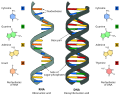 Difference DNA RNA
 -
 Ribonucleic acid chemical structure
 -
 Etls-2019-0024c.01


