Spore: Difference between revisions
CSV import |
CSV import |
||
| Line 44: | Line 44: | ||
{{stub}} | {{stub}} | ||
{{dictionary-stub1}} | {{dictionary-stub1}} | ||
<gallery> | |||
File:Sporic_meiosis.svg|Sporic meiosis | |||
File:Brachythecium_rutabulum_on_Populus_x_canadensis.jpg|Brachythecium rutabulum on Populus x canadensis | |||
File:Sporangium_of_fungi.jpg|Sporangium of fungi | |||
File:Rhizopus_zygospores.jpg|Rhizopus zygospores | |||
File:Bitunicate_ascus_and_ascospores_of_Didymella_rabiei.png|Bitunicate ascus and ascospores of Didymella rabiei | |||
File:Basidium_schematic.svg|Basidium schematic | |||
File:Aecium_sp.jpg|Aecium sp. | |||
File:Puccinia_thaliae_urediniospores.jpg|Puccinia thaliae urediniospores | |||
File:Puccinia_helianthi_(teliospores).jpg|Puccinia helianthi (teliospores) | |||
File:10554_oospore.jpg|Oospore | |||
File:Rhod1004.jpg|Rhod1004 | |||
File:Polysiphonia_tetraspores_WM2.jpg|Polysiphonia tetraspores WM2 | |||
</gallery> | |||
Latest revision as of 21:20, 23 February 2025
Spore
A Spore is a unit of sexual or asexual reproduction that may be adapted for dispersal and for survival, often for extended periods of time, in unfavorable conditions. Spores form part of the life cycles of many plants, algae, fungi and protozoa.<ref>
Spore(link). {{{website}}}.
</ref>
Bacterial spores[edit]
Bacterial spores are extremely durable and can survive in harsh conditions, such as extreme heat and lack of nutrients. They are formed by a process called sporulation, which is triggered by lack of nutrients and usually begins in the cell's vegetative state.
Fungal spores[edit]
Fungal spores are usually haploid and unicellular and are produced by meiosis in the sporangium of a dikaryotic fruiting body. Spores are capable of developing into a new organism using mitotic division, producing a multicellular thallus, which eventually goes on to produce more spores.
Plant spores[edit]
Plant spores are haploid and multicellular and are produced by meiosis in the sporangium of a diploid sporophyte. Under favourable conditions the spore can develop into a new organism using mitotic division, producing a multicellular gametophyte, which eventually goes on to produce gametes.
Protozoan spores[edit]
Protozoan spores are formed by some protozoa as a way to survive in a dormant state under unfavorable conditions. They are capable of surviving for long periods of time and can be spread through the air, water, and soil.
See also[edit]
References[edit]
<references />
External links[edit]
- Spore on Wikipedia
 | |
|---|---|
 |
 |
-
 Sporic meiosis
 -
 Brachythecium rutabulum on Populus x canadensis
 -
 Sporangium of fungi
 -
 Rhizopus zygospores
 -
 Bitunicate ascus and ascospores of Didymella rabiei
 -
 Basidium schematic
 -
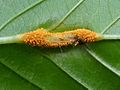 Aecium sp.
 -
 Puccinia thaliae urediniospores
 -
 Puccinia helianthi (teliospores)
 -
 Oospore
 -
 Rhod1004
 -
 Polysiphonia tetraspores WM2


.jpg)


