Rose bengal: Difference between revisions
CSV import |
CSV import Tags: mobile edit mobile web edit |
||
| Line 25: | Line 25: | ||
{{Chemical-compound-stub}} | {{Chemical-compound-stub}} | ||
{{Medicine-stub}} | {{Medicine-stub}} | ||
<gallery> | |||
File:rosebengalskeletal.png|Rose Bengal Skeletal | |||
File:Бенгальская_роза.jpg|Bengal Rose | |||
File:Spinoloricus.png|Spinoloricus | |||
File:Rose_bengal_sodium_salt_structure.png|Rose Bengal Sodium Salt Structure | |||
File:Rose_Bengal_Deneyi_öncesi.jpg|Rose Bengal Experiment Before | |||
File:Rose_Bengal_Deneyi.jpg|Rose Bengal Experiment | |||
</gallery> | |||
Latest revision as of 21:12, 23 February 2025
Rose Bengal is a dye that is used in medical and biological applications. It is a derivative of fluorescein, and is named for the bright pink color it imparts.
History[edit]
Rose Bengal was first prepared in 1882 by the German chemist Adolf von Baeyer, who was awarded the Nobel Prize in Chemistry in 1905 for his work on dyes and aromatic compounds. The dye was originally used in the textile industry, but its applications have since expanded to include medical and biological research.
Chemical Properties[edit]
Rose Bengal is a halogenated derivative of fluorescein. Its chemical formula is C20H2I4O5, and it has a molecular weight of 576.87 g/mol. The dye is a bright pink color and is soluble in water, ethanol, and acetone. It has a maximum absorption wavelength of 549 nm.
Medical Applications[edit]
In medicine, Rose Bengal is used in the Rose Bengal test, a diagnostic test for dry eye syndrome. The dye is applied to the eye, and if the eye is dry, the dye will stick to the cornea, indicating a positive result. Rose Bengal is also used in the diagnosis of corneal ulcers and herpes simplex virus infections of the eye.
In addition to its use in ophthalmology, Rose Bengal is used in the treatment of certain types of cancer. The dye is used in Photodynamic therapy, a treatment that uses light to activate a photosensitizing agent, in this case Rose Bengal, which then kills cancer cells.
Biological Applications[edit]
In biology, Rose Bengal is used as a stain to identify dead or damaged cells. The dye is taken up by these cells, making them easy to identify under a microscope. Rose Bengal is also used in the study of photosynthesis, as it can inhibit the process in certain organisms.
Safety[edit]
While Rose Bengal is generally considered safe for use in humans, it can cause side effects such as eye irritation or allergic reactions in some individuals. It is recommended that the dye be used with caution in individuals with known allergies to iodine.
This article is a Chemical compound-related stub. You can help WikiMD by expanding it!

-
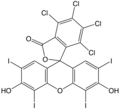 Rose Bengal Skeletal
 -
 Bengal Rose
 -
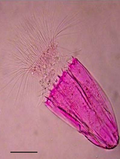 Spinoloricus
 -
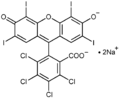 Rose Bengal Sodium Salt Structure
 -
 Rose Bengal Experiment Before
 -
 Rose Bengal Experiment


