Biological system: Difference between revisions
CSV import |
CSV import |
||
| Line 35: | Line 35: | ||
[[Category:Systems biology]] | [[Category:Systems biology]] | ||
{{biology-stub}} | {{biology-stub}} | ||
<gallery> | |||
File:TE-Nervous_system_diagram.svg|Nervous system diagram | |||
File:Endomembrane_system_diagram_en.svg|Endomembrane system diagram | |||
</gallery> | |||
Latest revision as of 21:10, 23 February 2025
Biological system refers to a complex network of biologically relevant entities. Biological systems are complex and they can be viewed under different aspects, so the same concepts and mathematical tools used for studying physical systems can be applied to biological systems.
Overview[edit]
A biological system is a complex network that it is much more than the sum of its parts. It is a system composed of many different parts that work together to achieve a certain objective. These systems can be biological organisms, such as a human being, or subsystems of these organisms, such as the circulatory system.
Components of a Biological System[edit]
Biological systems are made up of several different components, including cells, tissues, organs, and organ systems. Each of these components plays a crucial role in the overall function of the system.
Cells[edit]
Cells are the basic building blocks of all living things. They are the smallest units of life that can replicate independently, and they are often called the "building blocks of life". The human body, for example, is made up of trillions of cells.
Tissues[edit]
Tissues are groups of cells that have a similar structure and act together to perform a specific function. There are four basic types of tissue in the body: epithelial, connective, muscle, and nervous.
Organs[edit]
Organs are collections of tissues that work together to perform a specific function or set of functions. For example, the heart is an organ that pumps blood through the body.
Organ Systems[edit]
Organ systems are groups of organs that work together to perform complex functions. For example, the digestive system is a system of organs that breaks down food into energy for the body.
See Also[edit]

-
 Nervous system diagram
 -
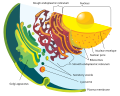 Endomembrane system diagram


