Luffa aegyptiaca: Difference between revisions
CSV import |
CSV import |
||
| (2 intermediate revisions by the same user not shown) | |||
| Line 1: | Line 1: | ||
'''Luffa aegyptiaca''' | = Luffa aegyptiaca = | ||
[[File:Luffa_aegyptiaca_compose.jpg|thumb|right|Luffa aegyptiaca plant with fruit]] | |||
'''Luffa aegyptiaca''', commonly known as the sponge gourd, Egyptian cucumber, or Vietnamese luffa, is a species of tropical and subtropical vine in the cucumber family. It is cultivated for its fruit, which is harvested before maturity and eaten as a vegetable, or allowed to mature and used as a natural cleaning sponge. | |||
== Description == | == Description == | ||
[[Luffa aegyptiaca]] is | [[File:Luffa_aegyptiaca_Blanco2.334-cropped.jpg|thumb|left|Illustration of Luffa aegyptiaca]] | ||
Luffa aegyptiaca is a vigorous climbing vine that can reach lengths of up to 15 meters. The plant has large, lobed leaves and yellow flowers. The fruit is cylindrical, green, and can grow up to 60 cm in length. When immature, the fruit is edible and has a mild flavor. As it matures, the interior becomes fibrous, forming a sponge-like texture. | |||
== Cultivation == | == Cultivation == | ||
Luffa aegyptiaca is grown in warm climates around the world. It requires a long growing season and thrives in well-drained soil with plenty of sunlight. The plant is typically grown on trellises to support the weight of the fruit and to ensure proper air circulation. | |||
== Uses == | == Uses == | ||
[[File:Luffa_sponge.png|thumb|right|Dried luffa sponge]] | |||
The young fruit of Luffa aegyptiaca is consumed as a vegetable in many Asian cuisines. It can be stir-fried, added to soups, or cooked in curries. The mature fruit is harvested for its fibrous interior, which is used as a natural sponge for cleaning and exfoliating the skin. | |||
== Cultural Significance == | |||
[[File:2008.09-331-196ap_Sponge_gourd,pd_Spice_Bazaar@Istanbul,TR_mon29sep2008-1315h.jpg|thumb|left|Sponge gourds for sale in a market]] | |||
In various cultures, Luffa aegyptiaca holds significance beyond its culinary and practical uses. In some regions, it is used in traditional medicine, while in others, it is a symbol of prosperity and abundance. | |||
== | == Distribution == | ||
Luffa aegyptiaca is native to South and Southeast Asia but is now grown in many parts of the world, including Africa, the Middle East, and the Americas. It is particularly popular in countries like India, China, and Vietnam. | |||
== | == Related Species == | ||
Luffa aegyptiaca is closely related to [[Luffa acutangula]], another species of luffa that is also cultivated for its edible fruit and fibrous interior. | |||
== Related Pages == | |||
* [[Cucurbitaceae]] | |||
* [[Luffa]] | * [[Luffa]] | ||
* [[ | * [[Vegetable]] | ||
* [[Sponge gourd | * [[Natural sponge]] | ||
== Gallery == | |||
<gallery> | |||
File:Sponge_gourd_of_Bangladesh.jpg|Sponge gourd in Bangladesh | |||
File:Kursi,_Golan_Heights_12.JPG|Luffa plant in the Golan Heights | |||
File:Beth_Alfa_Synagogue_Mosaic_08.JPG|Ancient mosaic depicting luffa | |||
</gallery> | |||
[[Category:Cucurbitaceae]] | [[Category:Cucurbitaceae]] | ||
[[Category: | [[Category:Edible plants]] | ||
[[Category: | [[Category:Vines]] | ||
Latest revision as of 14:15, 21 February 2025
Luffa aegyptiaca[edit]

Luffa aegyptiaca, commonly known as the sponge gourd, Egyptian cucumber, or Vietnamese luffa, is a species of tropical and subtropical vine in the cucumber family. It is cultivated for its fruit, which is harvested before maturity and eaten as a vegetable, or allowed to mature and used as a natural cleaning sponge.
Description[edit]

Luffa aegyptiaca is a vigorous climbing vine that can reach lengths of up to 15 meters. The plant has large, lobed leaves and yellow flowers. The fruit is cylindrical, green, and can grow up to 60 cm in length. When immature, the fruit is edible and has a mild flavor. As it matures, the interior becomes fibrous, forming a sponge-like texture.
Cultivation[edit]
Luffa aegyptiaca is grown in warm climates around the world. It requires a long growing season and thrives in well-drained soil with plenty of sunlight. The plant is typically grown on trellises to support the weight of the fruit and to ensure proper air circulation.
Uses[edit]

The young fruit of Luffa aegyptiaca is consumed as a vegetable in many Asian cuisines. It can be stir-fried, added to soups, or cooked in curries. The mature fruit is harvested for its fibrous interior, which is used as a natural sponge for cleaning and exfoliating the skin.
Cultural Significance[edit]

In various cultures, Luffa aegyptiaca holds significance beyond its culinary and practical uses. In some regions, it is used in traditional medicine, while in others, it is a symbol of prosperity and abundance.
Distribution[edit]
Luffa aegyptiaca is native to South and Southeast Asia but is now grown in many parts of the world, including Africa, the Middle East, and the Americas. It is particularly popular in countries like India, China, and Vietnam.
Related Species[edit]
Luffa aegyptiaca is closely related to Luffa acutangula, another species of luffa that is also cultivated for its edible fruit and fibrous interior.
Related Pages[edit]
Gallery[edit]
-
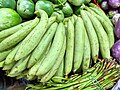 Sponge gourd in Bangladesh
 -
 Luffa plant in the Golan Heights
 -
 Ancient mosaic depicting luffa


