Mississauga: Difference between revisions
CSV import |
CSV import |
||
| Line 32: | Line 32: | ||
{{geo-stub}} | {{geo-stub}} | ||
<gallery> | |||
File:ValG MississaugaSkyline.jpg|Mississauga Skyline | |||
File:Mississauga Civic Centre (2009).jpg|Mississauga Civic Centre | |||
File:Health Sciences Complex.jpg|Health Sciences Complex | |||
File:Old Grammar School IDM 14583.jpg|Old Grammar School | |||
File:The Credit River, Mississauga (11791385864).jpg|The Credit River | |||
File:ValG StreetsvilleChurge1.jpg|Streetsville Church | |||
File:Absolute Mississauga May 2012.jpg|Absolute Towers | |||
File:ValG MississaugaLakeshore1.jpg|Mississauga Lakeshore | |||
File:Mcitytowers.jpg|M City Towers | |||
File:Mississauga Historic Municipalities.png|Historic Municipalities | |||
File:The Credit River, Mississauga, Ontario (21758612442).jpg|The Credit River | |||
File:ValG MississaugaSkyline.jpg|Mississauga Skyline | |||
</gallery> | |||
Latest revision as of 01:50, 20 February 2025
Mississauga is a city located in the province of Ontario, Canada. It is situated to the west of Toronto, the largest city in Canada, and is part of the Greater Toronto Area (GTA). With a population of over 700,000, Mississauga is the sixth-most populous municipality in Canada. The city has seen significant growth over the past few decades, transforming from a suburb of Toronto to a large urban center in its own right.
History[edit]
Mississauga's history dates back to the time when it was inhabited by the First Nations people, specifically the Anishinaabe group known as the Mississaugas, from whom the city takes its name. The area was first surveyed in 1805, and European settlement began in earnest in the 19th century. The city itself was established in 1974 through the amalgamation of several smaller communities including Streetsville, Meadowvale, and Port Credit.
Geography[edit]
Mississauga covers a wide area of approximately 292 square kilometers, bordered by Lake Ontario to the south, Oakville to the west, Brampton to the north, and Toronto to the east. The city features a variety of landscapes, including urban areas, residential neighborhoods, industrial sectors, and green spaces. The Credit River runs through the city, providing scenic vistas and recreational opportunities.
Economy[edit]
The economy of Mississauga is diverse, with strong sectors in pharmaceuticals, banking and finance, electronics, aerospace, and transportation and logistics. It is home to the headquarters of many Canadian and multinational corporations. The city's proximity to Toronto and major transportation hubs, such as Toronto Pearson International Airport, has made it an attractive location for businesses.
Demographics[edit]
Mississauga is known for its multicultural population. The city is home to a large number of immigrants, with over half of its residents born outside of Canada. This diversity is reflected in the city's cultural festivals, restaurants, and businesses.
Culture and Recreation[edit]
Mississauga boasts a vibrant cultural scene, with numerous festivals, art galleries, theaters, and concert venues. The Living Arts Centre is a key cultural facility, offering a range of performances and art exhibitions. The city also has extensive parklands and recreational facilities, including the waterfront at Port Credit, which offers marinas, parks, and entertainment areas.
Government[edit]
The city is governed by a mayor and a council, elected every four years. Mississauga has been noted for its efficient municipal government, with a strong emphasis on fiscal responsibility.
Education[edit]
Mississauga is served by the Peel District School Board and the Dufferin-Peel Catholic District School Board, which operate numerous public and Catholic schools throughout the city. It is also home to post-secondary institutions, including a campus of the University of Toronto and Sheridan College.
Transportation[edit]
Mississauga offers a comprehensive network of roads, including major highways such as the Queen Elizabeth Way (QEW) and Highways 401, 403, and 407. Public transportation is provided by MiWay, the city's own transit service, and it is also served by GO Transit, which offers commuter rail and bus services connecting to Toronto and other parts of the GTA.
Challenges and Future Development[edit]
As Mississauga continues to grow, it faces challenges related to urban sprawl, traffic congestion, and environmental sustainability. The city is actively working on developing its downtown core to create a more vibrant urban center, with plans for increased density, public transit improvements, and green initiatives.
-
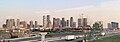 Mississauga Skyline
 -
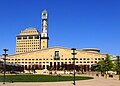 Mississauga Civic Centre
 -
 Health Sciences Complex
 -
 Old Grammar School
 -
 The Credit River
 -
 Streetsville Church
 -
 Absolute Towers
 -
 Mississauga Lakeshore
 -
M City Towers
-
Historic Municipalities
-
The Credit River
-
Mississauga Skyline

.jpg)


.jpg)


.jpg)
.jpg)


