Seitan: Difference between revisions
CSV import |
CSV import |
||
| Line 30: | Line 30: | ||
[[Category:Wheat]] | [[Category:Wheat]] | ||
{{food-stub}} | {{food-stub}} | ||
<gallery> | |||
File:Seitan Platter (4139727246).jpg|Seitan Platter | |||
File:Packaged Seitan.JPG|Packaged Seitan | |||
File:Frying seitan (4962744128).jpg|Frying Seitan | |||
File:Koufu (Wheat Gluten) Dish.jpg|Koufu (Wheat Gluten) Dish | |||
File:Japanese Wheat gluten Fu.JPG|Japanese Wheat Gluten Fu | |||
File:Veganz, Schivelbeiner Straße 34, Berlin, June 2012.jpg|Veganz, Schivelbeiner Straße 34, Berlin, June 2012 | |||
</gallery> | |||
Latest revision as of 01:18, 20 February 2025
Seitan is a popular meat substitute made from gluten, the main protein of wheat. Unlike many other vegetarian and vegan meat substitutes, seitan is not made from soy, but from wheat gluten. It is also known as wheat meat, wheat protein, or just gluten.
History[edit]
Seitan has been a common food in Asia for centuries. It was first developed by Buddhist monks in China, who were looking for a vegetarian substitute for meat. The term "seitan" itself comes from Japan, where it was coined by George Ohsawa, a proponent of the macrobiotic diet, in the 1960s.
Production[edit]
Seitan is made by washing wheat flour dough with water until all the starch granules have been removed, leaving the sticky insoluble gluten as an elastic mass, which is then cooked before being eaten.
Nutritional Value[edit]
Seitan is high in protein, making it a popular protein source for vegetarians and vegans. It also contains small amounts of iron, calcium, and phosphorus. However, because it is made from gluten, it is not suitable for people with celiac disease, gluten intolerance, or wheat allergy.
Culinary Uses[edit]
Seitan can be prepared in many ways, including simmering, grilling, or frying. It has a dense, chewy texture that is often described as similar to that of meat. It can be used in a variety of dishes, such as stir-fries, sandwiches, and stews, and can be flavored to taste like various meats.
See Also[edit]

-
 Seitan Platter
 -
 Packaged Seitan
 -
 Frying Seitan
 -
 Koufu (Wheat Gluten) Dish
 -
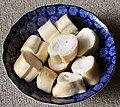 Japanese Wheat Gluten Fu
 -
 Veganz, Schivelbeiner Straße 34, Berlin, June 2012
.jpg)

.jpg)
_Dish.jpg)


