Cardiac catheterization: Difference between revisions
CSV import Tag: Replaced |
CSV import |
||
| Line 53: | Line 53: | ||
[[Category:Medical procedures]] | [[Category:Medical procedures]] | ||
[[Category:Interventional cardiology]] | [[Category:Interventional cardiology]] | ||
== Cardiac catheterization == | |||
<gallery> | |||
File:Cathlab.jpg|Cardiac catheterization | |||
File:Radial artery catheterization.jpg|Radial artery catheterization | |||
File:Left Heart Catheter.png|Left Heart Catheter | |||
File:Pulmonary artery Catheter.png|Pulmonary artery Catheter | |||
File:X-ray of pacemaker with right atrial and ventricular lead.jpg|X-ray of pacemaker with right atrial and ventricular lead | |||
File:Atrial septal defect-en.png|Atrial septal defect | |||
File:Takotsubo ventriculography.gif|Takotsubo ventriculography | |||
</gallery> | |||
Latest revision as of 00:52, 20 February 2025
| Pronunciation | |
|---|---|
| Other names | |
| Specialty | |
| Uses | |
| Complications | |
| Approach | |
| Types | |
| Recovery time | |
| Other options | |
| Frequency |
Cardiac catheterization is a medical procedure used to diagnose and treat certain cardiovascular conditions. During this procedure, a long thin tube called a catheter is inserted in an artery or vein in your groin, neck, or arm and threaded through your blood vessels to your heart.
Indications[edit]
Cardiac catheterization is used to investigate and treat a variety of heart conditions, including:
Procedure[edit]
The procedure is typically performed in a catheterization laboratory (cath lab) by a cardiologist and a specialized team of nurses and technicians. The patient is usually awake but sedated, and local anesthesia is applied to the insertion site.
Steps[edit]
1. **Preparation**: The patient is prepared and the insertion site is cleaned and numbed. 2. **Insertion**: A sheath is inserted into the blood vessel. 3. **Catheterization**: The catheter is guided through the blood vessels to the heart using fluoroscopy. 4. **Diagnosis and Treatment**: Various tests and treatments can be performed, such as angiography, angioplasty, or stent placement. 5. **Completion**: The catheter and sheath are removed, and pressure is applied to the insertion site to prevent bleeding.
Risks[edit]
While cardiac catheterization is generally safe, it does carry some risks, including:
Recovery[edit]
After the procedure, patients are monitored for several hours. They may need to lie flat for a few hours to prevent bleeding from the insertion site. Most patients can return to normal activities within a few days.
See also[edit]
References[edit]
<references group="" responsive="1"></references>
External links[edit]
Cardiac catheterization[edit]
-
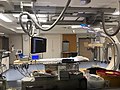 Cardiac catheterization
 -
 Radial artery catheterization
 -
 Left Heart Catheter
 -
 Pulmonary artery Catheter
 -
 X-ray of pacemaker with right atrial and ventricular lead
 -
 Atrial septal defect
 -
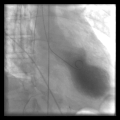 Takotsubo ventriculography


