Pionono: Difference between revisions
CSV import |
CSV import Tags: mobile edit mobile web edit |
||
| Line 37: | Line 37: | ||
[[Category:Philippine cuisine]] | [[Category:Philippine cuisine]] | ||
{{food-stub}} | {{food-stub}} | ||
<gallery> | |||
File:Granada-Day2-38_(48004314466).jpg|Pionono | |||
File:2191Poblacion,_Baliuag,_Bulacan_05.jpg|Pionono | |||
File:PioNono-Málaga.jpg|Pionono | |||
File:Piononos_de_Santa_Fé-Madrid.jpg|Pionono | |||
File:Piononos_agridulces_argentinos_caseros.JPG|Pionono | |||
File:Piononos_agridulces_argentinos_caseros_cortados.JPG|Pionono | |||
File:Piononos_dulces_argentinos_caseros.jpg|Pionono | |||
File:Pionono_dulce_argentino_casero_cortado.jpg|Pionono | |||
File:Arrolladodleche.jpg|Pionono | |||
File:Brazo_de_mercedes.jpg|Pionono | |||
File:FvfFoodsPhil9233_05.JPG|Pionono | |||
</gallery> | |||
Latest revision as of 12:20, 18 February 2025
Pionono is a type of pastry that originated from Spain, specifically from the town of Santa Fe, near Granada. It is named after Pope Pius IX, or Pio Nono in Spanish. Pionono is popular in various parts of the world, including Argentina, Peru, and the Philippines, where it has been adapted to local tastes and ingredients.
History[edit]
The Pionono was first created in the 19th century in honor of Pope Pius IX. The pastry was named after the Pope's affectionate nickname, Pio Nono. The original Pionono from Santa Fe is a small, sweet pastry, with a moist, spongy texture.
Variations[edit]
Argentina[edit]
In Argentina, the Pionono is typically prepared as a rolled cake filled with dulce de leche, cream, fruits, or other ingredients. It can be served as a dessert or as a savory dish, depending on the filling.
Peru[edit]
The Peruvian version of the Pionono is similar to the Argentine version, but it is typically filled with manjar blanco, a type of dulce de leche. It is often served as a dessert during special occasions.
Philippines[edit]
In the Philippines, the Pionono, also known as pianono, is a rolled cake or jelly roll. It is typically filled with butter and sugar, and then rolled into a log, sliced, and served as a dessert or snack.
See also[edit]
References[edit]
<references />

-
 Pionono
 -
 Pionono
 -
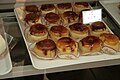 Pionono
 -
 Pionono
 -
 Pionono
 -
 Pionono
 -
 Pionono
 -
 Pionono
 -
 Pionono
 -
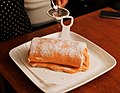 Pionono
 -
 Pionono
.jpg)


