Manchuria: Difference between revisions
CSV import |
CSV import |
||
| Line 26: | Line 26: | ||
{{stub}} | {{stub}} | ||
<gallery> | |||
File:Manchuria.png|Manchuria | |||
File:Amurrivermap.png|Amurrivermap | |||
File:John-Tallis-1851-Tibet-Mongolia-and-Manchuria-NE.jpg|John-Tallis-1851-Tibet-Mongolia-and-Manchuria-NE | |||
File:EB1911_Manchuria.png|EB1911 Manchuria | |||
File:Manchukuo_Railmap_en.png|Manchukuo Railmap | |||
File:Ming_divisions.png|Ming divisions | |||
File:The_Americana_-_a_universal_reference_library,_comprising_the_arts_and_sciences,_literature,_history,_biography,_geography,_commerce,_etc._of_the_world_(1903)_(14763639145).jpg|The Americana - a universal reference library | |||
File:Climate_Map_for_Manchuria-Northeast_China.png|Climate Map for Manchuria-Northeast China | |||
File:China_Railways_passenger_train_K1452_on_Binsui_railway_20120817.jpg|China Railways passenger train K1452 on Binsui railway | |||
File:Ussuriysk-Stone-Tortoise-S-3542.jpg|Ussuriysk Stone Tortoise | |||
File:Three_Kingdoms_of_Korea_Map.png|Three Kingdoms of Korea Map | |||
File:Yuan_dynasty_and_Manchuria.jpg|Yuan dynasty and Manchuria | |||
</gallery> | |||
Latest revision as of 12:20, 18 February 2025
Manchuria is a region in East Asia. Depending on the definition of its extent, Manchuria can either refer to a region falling entirely within China, or a larger region today divided between Northeast China and Russia's Far East. The Chinese definition refers to the three provinces of Heilongjiang, Jilin, and Liaoning, but the international definition also includes the eastern part of Inner Mongolia.
History[edit]
Manchuria has a long history of conquest and power struggles among various ethnic groups, including the Mohe, Jurchen, Mongols, and Manchu. The region was the homeland of the Manchu people who established the Qing dynasty, which ruled China from 1644 to 1912.
Geography[edit]
Manchuria is a region defined by its geography, with high mountains forming its eastern and southern boundaries. The region is also known for its vast forests and rich mineral resources.
Economy[edit]
Manchuria's economy is heavily dependent on its vast natural resources. The region is one of the world's largest suppliers of raw materials, including coal, oil, and iron ore. It also has a significant agricultural sector, producing crops such as soybeans, corn, and wheat.
Culture[edit]
Manchuria is home to a diverse range of cultures, with influences from the Manchu, Han Chinese, Korean, Mongol, and Russian cultures. The region is known for its traditional music, dance, and art, as well as its unique cuisine.
See also[edit]
 | |
|---|---|
 |
 |
-
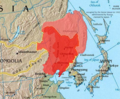 Manchuria
 -
 Amurrivermap
 -
 John-Tallis-1851-Tibet-Mongolia-and-Manchuria-NE
 -
 EB1911 Manchuria
 -
 Manchukuo Railmap
 -
 Ming divisions
 -
 The Americana - a universal reference library
 -
 Climate Map for Manchuria-Northeast China
 -
 China Railways passenger train K1452 on Binsui railway
 -
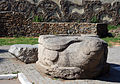 Ussuriysk Stone Tortoise
 -
 Three Kingdoms of Korea Map
 -
 Yuan dynasty and Manchuria


_(14763639145).jpg)


