Plateletpheresis: Difference between revisions
CSV import |
CSV import |
||
| Line 20: | Line 20: | ||
{{stub}} | {{stub}} | ||
== Plateletpheresis == | |||
<gallery> | |||
File:Platelet_blood_bag.jpg|Platelet blood bag | |||
File:Platelets_collected_by_using_apheresis.jpg|Platelets collected by using apheresis | |||
File:Plateletpheresis_machine.jpg|Plateletpheresis machine | |||
File:Plasma_and_platelet_donation.jpg|Plasma and platelet donation | |||
File:Apheresis_of_donated_platelets_2_units_in_Australia_2020.jpg|Apheresis of donated platelets, 2 units in Australia, 2020 | |||
File:JK_Double_Line_ThromboCytaPheresis.jpg|JK Double Line ThromboCytaPheresis | |||
File:Plateletpheresis_hematoma_2016.jpg|Plateletpheresis hematoma, 2016 | |||
</gallery> | |||
Latest revision as of 12:15, 18 February 2025
Plateletpheresis is a medical procedure that involves the collection of platelets, a type of blood cell that helps in clotting. The process is a type of apheresis, the more general term for separating out one particular constituent of blood and returning the remainder to the circulation.
Procedure[edit]
Plateletpheresis is performed in a medical laboratory or a hospital. The procedure involves drawing blood from the patient, separating and retaining the platelets, and returning the rest of the blood to the patient. This is usually done using a machine specifically designed for this purpose. The procedure can take up to two hours, and the number of platelets collected depends on the machine used and the donor's platelet count.
Uses[edit]
Plateletpheresis is used to collect platelets for transfusion. Platelet transfusions are needed by patients who have low platelet counts, a condition known as thrombocytopenia, or dysfunctional platelets. This can occur in patients with cancer, especially those receiving chemotherapy or radiation therapy, and in patients undergoing bone marrow transplants.
Risks and complications[edit]
As with any medical procedure, there are potential risks and complications associated with plateletpheresis. These can include reactions to the anticoagulant used in the procedure, low calcium levels, and injury to the vein from the needle. However, these risks are generally low and the procedure is considered safe.
See also[edit]
 | |
|---|---|
 |
 |
Plateletpheresis[edit]
-
 Platelet blood bag
 -
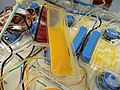 Platelets collected by using apheresis
 -
 Plateletpheresis machine
 -
 Plasma and platelet donation
 -
 Apheresis of donated platelets, 2 units in Australia, 2020
 -
JK Double Line ThromboCytaPheresis
-
 Plateletpheresis hematoma, 2016


