Drainage basin: Difference between revisions
CSV import |
CSV import |
||
| Line 38: | Line 38: | ||
{{Geography-stub}} | {{Geography-stub}} | ||
<gallery> | |||
File:Major_River_Systems_within_the_Mississippi_River_Basin.svg|Major River Systems within the Mississippi River Basin | |||
File:Ocean_drainage.png|Ocean Drainage | |||
File:Uureg_Nuur.jpg|Uureg Nuur | |||
File:Ohiorivermap.png|Ohio River Map | |||
File:Hydrographic_basin.svg|Hydrographic Basin | |||
File:EN_Bazinul_hidrografic_al_Raului_Latorita,_Romania.jpg|Bazinul hidrografic al Raului Latorita, Romania | |||
</gallery> | |||
Latest revision as of 10:59, 18 February 2025
Drainage Basin
A drainage basin is an area of land where precipitation collects and drains off into a common outlet, such as into a river, bay, or other body of water. Drainage basins are significant in determining water flow and ecosystem health within their boundaries. They are also known as watersheds, catchment areas, or catchment basins.
Overview[edit]
The boundaries of a drainage basin are defined by the topography of the land, where all water falling within the area is funneled to a single point. This point is usually a river or stream that eventually carries the water to an ocean, lake, or another river. The size of a drainage basin can vary significantly, from a few square kilometers for small creeks to millions of square kilometers for the largest river systems.
Formation[edit]
Drainage basins are formed by geological and topographical factors. The shape and structure of the landscape, influenced by the underlying geology, dictate the direction and flow of water. Erosion plays a crucial role in shaping drainage basins by wearing away rock and soil, creating river valleys and channels.
Components[edit]
A drainage basin comprises various features, including rivers, lakes, streams, and wetlands. The main river of a drainage basin is called the main stem. Tributaries are smaller rivers or streams that flow into the main stem. The area where two rivers meet, called a confluence, is often a critical ecological and hydrological point within the basin.
Importance[edit]
Drainage basins are essential for several reasons:
- Water Cycle: They play a crucial role in the global water cycle, collecting precipitation and channeling it into the oceans.
- Ecosystems: Basins support diverse ecosystems, providing habitats for a wide range of plant and animal species.
- Human Use: Humans rely on drainage basins for freshwater supply, agriculture, and hydroelectric power generation.
Management[edit]
Effective management of drainage basins is vital for water quality, flood prevention, and ecosystem conservation. This involves monitoring water flow, controlling pollution, and protecting natural habitats. Integrated Water Resources Management (IWRM) is a process that promotes the coordinated development and management of water, land, and related resources across drainage basins to maximize economic and social welfare without compromising the sustainability of vital ecosystems.
Challenges[edit]
Drainage basins face several challenges, including:
- Pollution: Industrial, agricultural, and urban runoff can contaminate waterways.
- Climate Change: Altered precipitation patterns and increased evaporation rates can affect water availability.
- Overuse: Excessive withdrawal of water for human use can lead to habitat destruction and reduced water quality.
See Also[edit]

-
 Major River Systems within the Mississippi River Basin
 -
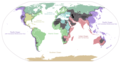 Ocean Drainage
 -
 Uureg Nuur
 -
 Ohio River Map
 -
 Hydrographic Basin
 -
 Bazinul hidrografic al Raului Latorita, Romania


