Personal trainer: Difference between revisions
CSV import Tags: mobile edit mobile web edit |
CSV import |
||
| Line 31: | Line 31: | ||
{{Health-stub}} | {{Health-stub}} | ||
{{Exercise-stub}} | {{Exercise-stub}} | ||
<gallery> | |||
File:Two_people_in_a_gym_using_BOSU_balls.jpg|Two people in a gym using BOSU balls | |||
File:Personal_trainer_assessing_a_client's_goals_and_needs_as_they_write_a_fitness_programme.jpg|Personal trainer assessing a client's goals and needs as they write a fitness programme | |||
File:Personal_Training_at_a_Gym_-_Cable_Crossover.JPG|Personal training at a gym - Cable Crossover | |||
File:MARIANA_DE_MELO.JPG|Personal trainer | |||
</gallery> | |||
Latest revision as of 04:43, 18 February 2025
Personal trainer
A Personal trainer is a certified professional who possesses the knowledge, skills, and abilities to design safe and effective fitness programs that help individuals achieve their personal health and fitness goals. Personal trainers often work in fitness clubs, but they can also work independently or in clients' homes.
History[edit]
The profession of personal training originated in the early 20th century when the first fitness professionals were hired to improve the physical condition of military personnel. The profession has since evolved and expanded, with personal trainers now working in a variety of settings and with a wide range of clients.
Roles and Responsibilities[edit]
Personal trainers are responsible for developing and implementing a comprehensive exercise program for their clients. This includes conducting fitness assessments, designing individualized exercise programs, providing instruction on exercise techniques, and monitoring progress. They also provide education and guidance on nutrition, lifestyle changes, and behavior modification to support overall health and wellness.
Certification and Education[edit]
To become a personal trainer, individuals typically need to earn a certification from a recognized organization such as the American Council on Exercise (ACE), the National Academy of Sports Medicine (NASM), or the International Sports Sciences Association (ISSA). These certifications require candidates to pass an exam that covers topics such as anatomy, exercise physiology, program design, and client relations. Some personal trainers also hold degrees in fields such as exercise science, kinesiology, or physical education.
Benefits of Hiring a Personal Trainer[edit]
Hiring a personal trainer can provide a number of benefits. Personal trainers can provide motivation, accountability, and personalized instruction to help individuals achieve their fitness goals. They can also help prevent injuries by teaching proper exercise form and technique. In addition, personal trainers can provide support and guidance for individuals with specific health conditions or fitness needs.
See Also[edit]

This exercise related article is a stub. You can help WikiMD by expanding it.
-
 Two people in a gym using BOSU balls
 -
 Personal trainer assessing a client's goals and needs as they write a fitness programme
 -
 Personal training at a gym - Cable Crossover
 -
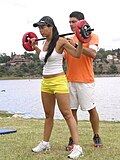 Personal trainer


