Morchella esculenta: Difference between revisions
CSV import Tags: mobile edit mobile web edit |
CSV import |
||
| Line 26: | Line 26: | ||
[[Category:Fungi of North America]] | [[Category:Fungi of North America]] | ||
[[Category:Fungi described in 1753]] | [[Category:Fungi described in 1753]] | ||
<gallery> | |||
File:Morchella_esculenta_-_DE_-_TH_-_2013-05-01_-_01.JPG|Morchella esculenta in Germany | |||
File:Speisemorchel-1.jpg|Morchella esculenta | |||
File:Morille.JPG|Morchella esculenta | |||
</gallery> | |||
Latest revision as of 04:27, 18 February 2025
Morchella esculenta, commonly known as the yellow morel, common morel, morel mushroom, or sponge morel, is a species of fungus in the family Morchellaceae of the Ascomycota. It is one of the most readily recognized of all the edible mushrooms and highly sought after.
Taxonomy[edit]
The scientific name Morchella esculenta derives from the Latin morchella, meaning mushroom, and esculenta, meaning edible. It was first described scientifically by Carl Linnaeus in 1753.
Description[edit]
Morchella esculenta is characterized by its distinctive honeycomb appearance. The cap is typically 2–7 cm high and 2–5 cm wide, with ridges that are usually buff or tan, and pits that are lemon-yellow to yellow-brown. The stipe is white or cream-colored, hollow, and more or less equal in width throughout its length.
Distribution and habitat[edit]
Morchella esculenta is found in North America, Europe, Asia, and Australia. It is commonly found in forests, orchards, gardens, and sometimes in grasslands, often in close association with certain types of trees, particularly ash, elm, and apple.
Culinary uses[edit]
Morchella esculenta is highly prized as a food. It is collected, sold, and eaten worldwide. It is used in various culinary dishes, often sautéed with onions and garlic, or used in soups, sauces, or stuffings.
See also[edit]
References[edit]
<references />
This mushroom-related article is a stub. You can help WikiMD by expanding it.
-
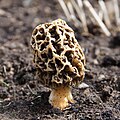 Morchella esculenta in Germany
 -
 Morchella esculenta
 -
 Morchella esculenta


