Lactarius indigo: Difference between revisions
CSV import |
CSV import |
||
| Line 17: | Line 17: | ||
[[Category:Lactarius]] | [[Category:Lactarius]] | ||
{{Mycology-stub}} | {{Mycology-stub}} | ||
<gallery> | |||
File:Lactarius_indigo_7283.jpg|Lactarius indigo mushroom in forest | |||
File:Lactarius_azulene.png|Close-up of Lactarius indigo cap | |||
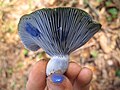
File:Lactarius_indigo_19700.jpg|Lactarius indigo showing blue gills | |||
</gallery> | |||
Latest revision as of 01:51, 18 February 2025

Lactarius indigo is a species of mushroom belonging to the genus Lactarius. It is notable for its striking blue color, which fades to green when the mushroom is handled or injured. This species is one of the few mushrooms that produce a blue milk or latex when the flesh is damaged, a characteristic trait of the Lactarius genus. Lactarius indigo is found primarily in forests of North America and Central America, where it grows in association with various types of trees, particularly with oaks (Quercus spp.) and pines (Pinus spp.), in a mycorrhizal relationship.
Description[edit]
Lactarius indigo features a cap that ranges from 5 to 15 cm in diameter, initially convex before becoming depressed in the center with age. The cap's surface is smooth and moist, displaying a vibrant indigo blue color that fades to a lighter shade of blue or green with age or when bruised. The gills are attached to the stem, closely spaced, and share the cap's blue color, which also fades upon injury. The stem of the mushroom is solid, cylindrical, and bears the same distinctive blue coloration, which may become hollow with age. When cut or damaged, the mushroom exudes a blue milk or latex, which is a hallmark of the Lactarius species.
Habitat and Distribution[edit]
Lactarius indigo is predominantly found in the woodlands of North and Central America, thriving in both deciduous and coniferous forests. It forms symbiotic mycorrhizal relationships with the roots of trees, aiding in nutrient exchange and promoting forest health. This species prefers moist, well-drained soils and is typically found in the late summer to fall months.
Edibility[edit]
Lactarius indigo is considered edible, with a mild to slightly acrid taste. It is often used as a colorful addition to various dishes. However, as with all wild mushrooms, caution is advised when foraging, as identification can be challenging, and some Lactarius species are known to be toxic.
Conservation[edit]
While Lactarius indigo does not currently face any major threats, habitat destruction and climate change could potentially impact its populations. Conservation efforts aimed at preserving forest ecosystems indirectly contribute to the protection of this and other mycorrhizal mushroom species.

-
 Lactarius indigo mushroom in forest
 -
 Close-up of Lactarius indigo cap
 -
 Lactarius indigo showing blue gills


