Multigrain bread: Difference between revisions
CSV import |
CSV import |
||
| Line 18: | Line 18: | ||
[[Category:Whole grain foods]] | [[Category:Whole grain foods]] | ||
{{food-stub}} | {{food-stub}} | ||
==Multigrain_bread== | |||
<gallery> | |||
File:Multigrain.jpg|Multigrain bread | |||
File:Essene_Bread_70pct_Rye_Sproud_30pct_Spelt_cut.JPG|Essene bread with 70% rye and 30% spelt | |||
</gallery> | |||
Latest revision as of 01:20, 18 February 2025
Multigrain bread is a type of bread made with two or more types of grain. Grains used include barley, flax, millet, oats, wheat, and corn. In addition to the variety of grains included, multigrain bread may also contain whole grains, which are a rich source of dietary fiber, B vitamins, and minerals.
History[edit]
The history of multigrain bread is tied to the history of bread itself. Bread has been a staple food for humans for thousands of years, and the use of multiple grains in bread-making dates back to ancient times. The Ancient Egyptians are known to have made bread with emmer and barley, while the Romans used a variety of grains including spelt, rye, and oats.
Health Benefits[edit]
Multigrain bread is often recommended as part of a healthy diet due to its high fiber content and the presence of multiple grains. The different grains contribute a variety of nutrients, making multigrain bread a more nutritionally complete food than bread made from a single type of grain. The high fiber content can aid in digestion and help to control blood sugar levels.
Production[edit]
The production of multigrain bread involves the mixing of different grain flours with water, yeast, and salt. The dough is then kneaded, allowed to rise, and baked. The specific proportions of the different grains used can vary, and additional ingredients such as nuts and seeds may be included for added texture and flavor.
See Also[edit]

Multigrain_bread[edit]
-
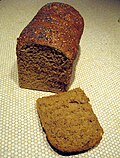 Multigrain bread
 -
 Essene bread with 70% rye and 30% spelt


