Dermoepidermal junction: Difference between revisions
CSV import Tags: mobile edit mobile web edit |
CSV import |
||
| Line 23: | Line 23: | ||
{{Medicine-stub}} | {{Medicine-stub}} | ||
== Dermoepidermal junction == | |||
<gallery> | |||
File:Epidermis,_papillary_dermis_and_reticular_dermis.png|Epidermis, papillary dermis and reticular dermis | |||
</gallery> | |||
Latest revision as of 01:54, 17 February 2025
Dermoepidermal Junction
The dermoepidermal junction (DEJ) is a critical structure within the skin that serves as the interface between the epidermis and the dermis. This complex structure plays a pivotal role in maintaining skin integrity, facilitating nutrient exchange, and supporting the skin's mechanical resistance. Understanding the DEJ is essential for comprehending various skin diseases and conditions, as well as for the development of dermatological treatments.
Structure and Function[edit]
The dermoepidermal junction is composed of a basal lamina that separates the epidermis from the dermis. This lamina is further divided into two layers: the lamina lucida and the lamina densa. The DEJ's structure is reinforced by anchoring fibrils, primarily composed of collagen VII, which extend into the dermis, providing mechanical support and stability to the skin.
The primary function of the DEJ is to anchor the epidermis to the dermis, preventing the two layers from shearing apart under mechanical stress. Additionally, the DEJ facilitates the exchange of nutrients and waste products between the epidermis and dermis. It also plays a crucial role in the skin's repair process following injury.
Clinical Significance[edit]
Alterations or damage to the dermoepidermal junction can lead to a variety of skin disorders. For example, autoimmune diseases such as bullous pemphigoid target proteins within the DEJ, leading to blistering and skin fragility. Similarly, mutations affecting the genes encoding for components of the DEJ can result in genetic disorders like epidermolysis bullosa, characterized by extreme skin fragility and blistering.
Understanding the DEJ is also vital for dermatological and cosmetic procedures, including laser therapy and skin grafting. Knowledge of this junction helps in minimizing damage and promoting effective healing.
Research and Developments[edit]
Recent advances in molecular biology and microscopy have allowed for a deeper understanding of the DEJ's composition and function. Studies focusing on the regeneration of the DEJ are particularly promising for improving outcomes in wound healing and in the treatment of degenerative skin diseases. Furthermore, research into the DEJ's role in skin aging and cancer metastasis is ongoing, with the potential to inform new therapeutic strategies.
Conclusion[edit]
The dermoepidermal junction is a fundamental component of the skin, essential for its structural integrity and function. Ongoing research into its complex structure and role in disease processes holds promise for the development of novel dermatological treatments.

Dermoepidermal junction[edit]
-
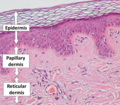 Epidermis, papillary dermis and reticular dermis

