Champorado: Difference between revisions
CSV import |
CSV import |
||
| Line 23: | Line 23: | ||
{{Philippine-cuisine-stub}} | {{Philippine-cuisine-stub}} | ||
{{food-stub}} | {{food-stub}} | ||
<gallery> | |||
File:Champorado.jpg|A bowl of champorado, a chocolate rice porridge. | |||
File:Champorado_chocolate_packages_01.jpg|Packages of chocolate used for making champorado. | |||
</gallery> | |||
Latest revision as of 01:52, 17 February 2025
Champorado is a traditional Filipino sweet porridge made from glutinous rice, cocoa powder, and sugar. It is often served with milk and tuyo, a type of dried fish.
History[edit]
The dish is believed to have been introduced to the Philippines during the Spanish colonial period, as a derivative of the Mexican drink champurrado. Over time, it has evolved into a distinct Filipino dish, with variations in ingredients and preparation methods.
Preparation[edit]
To prepare champorado, glutinous rice is first soaked in water to soften. It is then boiled with cocoa powder and sugar until it reaches a thick, porridge-like consistency. Some versions may also include coconut milk for added richness. The dish is typically served hot, with milk and tuyo on the side.
Cultural Significance[edit]
Champorado is often associated with the rainy season in the Philippines, as it is considered a comfort food during cold weather. It is also a popular breakfast dish, and is commonly served during special occasions and festivals.
Variations[edit]
There are several variations of champorado in the Philippines, including white champorado (made without cocoa), and champorado with ube (purple yam). Some versions may also include additional ingredients such as peanut butter, vanilla, or cinnamon.
See Also[edit]


-
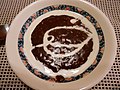 A bowl of champorado, a chocolate rice porridge.
 -
 Packages of chocolate used for making champorado.


