Qurabiya
Qurabiya is a type of almond cookie that originated from the Middle East. It is also known by various other names such as kurabiye in Turkey, ghorayeba in Egypt, and gurabija in Albania, North Macedonia, and Serbia. The cookie is typically made with a simple recipe of almonds, sugar, and egg whites.
History[edit]
The origins of qurabiya can be traced back to the Persian Empire, where it was a popular treat among the nobility. The recipe was later spread to other parts of the Middle East and the Mediterranean region through trade and conquest. In the Ottoman Empire, qurabiya was often served at royal banquets and special occasions.
Preparation[edit]
The preparation of qurabiya involves mixing ground almonds with sugar and egg whites to form a dough. The dough is then shaped into small balls or crescents and baked until golden brown. Some variations of the recipe may include additional ingredients such as vanilla, rose water, or pistachios.
Nutritional Value[edit]
Qurabiya is high in protein and healthy fats due to its almond content. However, it is also high in sugar, making it a high-calorie food. It is best consumed in moderation as part of a balanced diet.
Cultural Significance[edit]
In many cultures, qurabiya is associated with celebrations and special occasions. For example, in Turkey, it is often served during Eid al-Fitr, the festival marking the end of Ramadan. In Albania, North Macedonia, and Serbia, gurabija is traditionally prepared for Christmas and Easter.
See Also[edit]

 | This medical article is a stub. You can help WikiMD by expanding the page. |
-
 Gurabija (гурабија, Qurabiya; Cuisine of Serbia)
 -
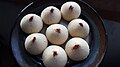 Ghribia algérienne
 -
 Kurabiyes in the form of medialuna
 -
 Kourabiedes platter
 -
 Təbriz qurabiyəsi
 -
 A Box of Qurabiya by Nobari Confectionary (Tehran, Iran)
 -
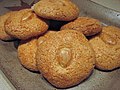 Acibadem Kurabiyesi
.jpg)


.jpg)

Medical Disclaimer: WikiMD is for informational purposes only and is not a substitute for professional medical advice. Content may be inaccurate or outdated and should not be used for diagnosis or treatment. Always consult your healthcare provider for medical decisions. Verify information with trusted sources such as CDC.gov and NIH.gov. By using this site, you agree that WikiMD is not liable for any outcomes related to its content. See full disclaimer.
Credits:Most images are courtesy of Wikimedia commons, and templates, categories Wikipedia, licensed under CC BY SA or similar.
Translate this page: - East Asian
中文,
日本,
한국어,
South Asian
हिन्दी,
தமிழ்,
తెలుగు,
Urdu,
ಕನ್ನಡ,
Southeast Asian
Indonesian,
Vietnamese,
Thai,
မြန်မာဘာသာ,
বাংলা
European
español,
Deutsch,
français,
Greek,
português do Brasil,
polski,
română,
русский,
Nederlands,
norsk,
svenska,
suomi,
Italian
Middle Eastern & African
عربى,
Turkish,
Persian,
Hebrew,
Afrikaans,
isiZulu,
Kiswahili,
Other
Bulgarian,
Hungarian,
Czech,
Swedish,
മലയാളം,
मराठी,
ਪੰਜਾਬੀ,
ગુજરાતી,
Portuguese,
Ukrainian
