Ytterbium
Ytterbium is a chemical element with the symbol Yb and atomic number 70. It is a lanthanide, a rare earth element, originally discovered by Swiss chemist Jean Charles Galissard de Marignac in the mineral gadolinite in 1878. Marignac named the element after the village of Ytterby in Sweden, where large concentrations of rare earth elements were discovered.
Characteristics[edit]
Ytterbium is a soft, malleable and ductile chemical element that displays a bright silvery luster when pure. It is a rare earth element, and it is readily attacked and dissolved by mineral acids, slowly reacts with water, and oxidizes in air.
Isotopes[edit]
Ytterbium has seven stable isotopes, and 16 radioisotopes, the most stable of which is Yb-169 with a half-life of 32 days. Yb-169 is used in industrial radiography.
Applications[edit]
Ytterbium is used in a variety of applications. It is often used in the production of stainless steel and other alloys. It is also used in lasers, particularly solid-state lasers. Ytterbium isotopes are also used in medical and industrial radiography.
Health effects[edit]
While ytterbium is not known to have a biological role, it has been noted to stimulate metabolism. Compounds of ytterbium are rarely encountered by most people, but some can be toxic if ingested in large amounts.
See also[edit]
| Chemical elements | ||||||||
|---|---|---|---|---|---|---|---|---|
This Chemical elements related article is a stub.
|
| Lanthanides | ||||
|---|---|---|---|---|
This lanthanides related article is a stub.
|

This WikiMD article can only be edited by registered and verified editors. You can log in or register.
-
 Euxenite from Vegusdal, Norway
 -
 Ytterbium(III) oxide
 -
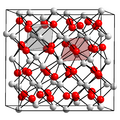 Crystal structure of Lanthanoid C-Type
 -
 Galissard de Marignac

_oxide.jpg)


Advertise on WikiMD — 81,000+ full articles, ~900,000 total pages, ~250 million page views. Global reach, limited time promotional rates from $1/page/day. Learn more · View stats

Translate page: - East Asian
中文,
日本,
한국어,
South Asian
हिन्दी,
தமிழ்,
తెలుగు,
Urdu,
ಕನ್ನಡ,
Southeast Asian
Indonesian,
Vietnamese,
Thai,
မြန်မာဘာသာ,
বাংলা
European
español,
Deutsch,
français,
Greek,
português do Brasil,
polski,
română,
русский,
Nederlands,
norsk,
svenska,
suomi,
Italian
Middle Eastern & African
عربى,
Turkish,
Persian,
Hebrew,
Afrikaans,
isiZulu,
Kiswahili,
Other
Bulgarian,
Hungarian,
Czech,
Swedish,
മലയാളം,
मराठी,
ਪੰਜਾਬੀ,
ગુજરાતી,
Portuguese,
Ukrainian
About WikiMD • Contact • Disclaimer • Privacy • Copyright • Site statistics
Some content and images may originate from Wikimedia Commons or Wikipedia and remain subject to their stated licenses. Unless otherwise noted, eligible WikiMD content is available under CC BY-SA 4.0.
WikiMD Wellnesspedia — Free health & wellness information for patients, students, and health professionals.

