Wound Man
The Wound Man is an illustrative figure that appears in surgical and medical texts from the late Middle Ages and the Renaissance. It depicts a human (usually male) standing with arms slightly outstretched, displaying a variety of wounds and traumas throughout the body. These illustrations served as a visual guide for treating injuries related to warfare, accidents, and surgical procedures. The Wound Man is a significant historical artifact, illustrating the state of medical knowledge and the types of injuries that were common or of concern at the time.
Origins and History[edit]
The earliest known version of the Wound Man appears in European surgical manuals of the 15th century, although the concept may have older roots. The image encapsulates the medical knowledge of the time, combining practical treatment advice with a compendium of possible injuries. It was a time when medicine was closely linked with both the study of anatomy and the practice of surgery, and the Wound Man served as an educational tool for physicians and barber-surgeons.
Description[edit]
The Wound Man typically shows a variety of injuries, including cuts, punctures, and fractures, as well as diseases and conditions such as tumors and skin infections. The figure also often includes representations of treatments, such as bandaging techniques and the removal of arrows or other foreign objects. Each wound or condition is usually labeled, providing a guide to treatment options available at the time.
Significance[edit]
The Wound Man is more than just a medical illustration; it is a window into the medical practices and challenges of the past. It reflects the types of injuries that were prevalent or of particular concern, such as those sustained in battle or through accidents. Additionally, it demonstrates the intersection of medical knowledge and societal needs, showing how physicians and surgeons were expected to treat a wide range of conditions.
Legacy[edit]
While the Wound Man is primarily of historical interest today, it remains a fascinating example of early medical illustration and education. It highlights the evolution of medical knowledge and the ways in which practitioners of the past visualized and categorized injuries. Modern medical education still uses illustrations to teach anatomy and treatment, though with far greater accuracy and detail, thanks in part to advances in medical science and technology.
See Also[edit]
 | This medical article is a stub. You can help WikiMD by expanding the page. |
Wound_Man[edit]
-
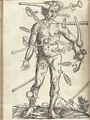 Wound Man from Hans von Gersdorff's "Feldbuch der Wundarzney"
 -
Wound Man from Johannes de Ketham's "Fasciculus Medicinae"
-
Wound Man with injuries, legend in German

Sponsored Health Resource

W8MD Weight Loss, Sleep & MedSpa
Looking for physician-supervised weight loss, semaglutide, tirzepatide, or GLP-1 receptor agonist options? W8MD helps eligible patients in New York City, Brooklyn, New Jersey, Connecticut, Pennsylvania, Delaware, and greater Philadelphia with medical weight loss, sleep medicine, and long-term maintenance support.
GLP-1 specials: Affordable GLP-1 injections NYC and Philadelphia starting from $29.99/week and up for semaglutide with insurance accepted for qualifying visits, and $45/week and up for tirzepatide with insurance accepted for qualifying visits. Self-pay options start from $59.99/week and up for semaglutide and $69.99/week and up for tirzepatide.
- Medical weight loss NYC
- Affordable GLP-1 injections NYC
- Budget GLP-1 weight loss shots Philadelphia
- New Jersey medical weight loss
- NYC medical weight loss blog
- Philadelphia weight loss blog
- Sleep medicine and sleep apnea services
- W8MD MedSpa and wellness
Book a W8MD appointment · View GLP-1 specials
Paid promotional message. Eligibility, pricing, insurance coverage, medication availability, and results vary. Medical evaluation required.

Medical Disclaimer: WikiMD is for informational purposes only and is not a substitute for professional medical advice. Content may be inaccurate or outdated and should not be used for diagnosis or treatment. Always consult your healthcare provider for medical decisions. Verify information with trusted sources such as CDC.gov and NIH.gov. By using this site, you agree that WikiMD is not liable for any outcomes related to its content. See full disclaimer.
Credits:Most images are courtesy of Wikimedia commons, and templates, categories Wikipedia, licensed under CC BY SA or similar.
Translate page: - East Asian
中文,
日本,
한국어,
South Asian
हिन्दी,
தமிழ்,
తెలుగు,
Urdu,
ಕನ್ನಡ,
Southeast Asian
Indonesian,
Vietnamese,
Thai,
မြန်မာဘာသာ,
বাংলা
European
español,
Deutsch,
français,
Greek,
português do Brasil,
polski,
română,
русский,
Nederlands,
norsk,
svenska,
suomi,
Italian
Middle Eastern & African
عربى,
Turkish,
Persian,
Hebrew,
Afrikaans,
isiZulu,
Kiswahili,
Other
Bulgarian,
Hungarian,
Czech,
Swedish,
മലയാളം,
मराठी,
ਪੰਜਾਬੀ,
ગુજરાતી,
Portuguese,
Ukrainian


