William Cullen
William Cullen (1710–1790) was a Scottish physician, chemist, and agriculturalist who made significant contributions to the advancement of medicine and science in the 18th century. He is best remembered for his pioneering work in the fields of chemistry and therapeutics, and as a founding figure in the Scottish Enlightenment.
Early Life and Education[edit]
William Cullen was born in Hamilton, Scotland, in 1710. He initially apprenticed as a surgeon before attending the University of Glasgow, where he developed an interest in chemistry. Cullen's early career was marked by a broad range of interests, including medicine, chemistry, and botany.
Career[edit]
Cullen's career spanned several decades, during which he held various prestigious positions. He served as a professor at both the University of Glasgow and the University of Edinburgh, two of the leading universities in Scotland. At Edinburgh, he was instrumental in establishing the city as a major center for medical education and research.
Contributions to Medicine[edit]
Cullen is perhaps best known for his contributions to medicine. He was a proponent of a more rational and empirical approach to medical practice, emphasizing the importance of observation and experience. His lectures and writings helped shape the development of modern clinical practice and medical education.
One of Cullen's significant contributions to medicine was his classification of diseases. He attempted to categorize diseases based on their symptoms and the parts of the body they affected, which was an innovative approach at the time.
Contributions to Chemistry[edit]
In addition to his medical work, Cullen made substantial contributions to the field of chemistry. He is credited with one of the first artificial refrigeration experiments, demonstrating the cooling effects of the evaporation of volatile liquids. This work laid the groundwork for the later development of refrigeration technology.
Legacy[edit]
William Cullen's legacy is marked by his contributions to the advancement of medicine and science. His approach to medical education, emphasizing empirical observation and the scientific method, influenced generations of physicians and scientists. The Cullen Prize at the University of Edinburgh is named in his honor, recognizing outstanding research in medicine.
Cullen was also a key figure in the Scottish Enlightenment, a period marked by significant advancements in science, philosophy, and economics. His work exemplifies the Enlightenment ideals of rational inquiry and the pursuit of knowledge.
Death[edit]
William Cullen passed away in 1790 in Edinburgh, leaving behind a legacy as one of Scotland's most influential physicians and scientists.
 | This medical article is a stub. You can help WikiMD by expanding the page. |
-
Portrait of William Cullen
-
Cameo of William Cullen, Hunterian Museum, Glasgow
-
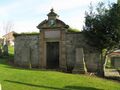 Burial enclosure of William and Robert Cullen


Medical Disclaimer: WikiMD is for informational purposes only and is not a substitute for professional medical advice. Content may be inaccurate or outdated and should not be used for diagnosis or treatment. Always consult your healthcare provider for medical decisions. Verify information with trusted sources such as CDC.gov and NIH.gov. By using this site, you agree that WikiMD is not liable for any outcomes related to its content. See full disclaimer.
Credits:Most images are courtesy of Wikimedia commons, and templates, categories Wikipedia, licensed under CC BY SA or similar.
Translate page: - East Asian
中文,
日本,
한국어,
South Asian
हिन्दी,
தமிழ்,
తెలుగు,
Urdu,
ಕನ್ನಡ,
Southeast Asian
Indonesian,
Vietnamese,
Thai,
မြန်မာဘာသာ,
বাংলা
European
español,
Deutsch,
français,
Greek,
português do Brasil,
polski,
română,
русский,
Nederlands,
norsk,
svenska,
suomi,
Italian
Middle Eastern & African
عربى,
Turkish,
Persian,
Hebrew,
Afrikaans,
isiZulu,
Kiswahili,
Other
Bulgarian,
Hungarian,
Czech,
Swedish,
മലയാളം,
मराठी,
ਪੰਜਾਬੀ,
ગુજરાતી,
Portuguese,
Ukrainian


,_Hunterian_Museum,_Glasgow.jpg)