WNK4
WNK4 (With No Lysine (K) 4) is a protein that in humans is encoded by the WNK4 gene. It is a member of the WNK family of serine-threonine kinases, which are known for their unusual placement of the catalytic lysine. WNK4 plays a crucial role in maintaining potassium balance and blood pressure regulation in the body.
Function[edit]
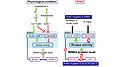
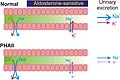
WNK4 is primarily expressed in the kidney and plays a significant role in the regulation of ion transport across cell membranes. It influences the activity of several ion channels and transporters, including the thiazide-sensitive Na-Cl cotransporter (NCC), the epithelial sodium channel (ENaC), and the renal outer medullary potassium channel (ROMK).
Clinical significance[edit]
Mutations in the WNK4 gene can lead to a rare form of hypertension known as pseudohypoaldosteronism type II (PHAII), also known as Gordon's syndrome. This condition is characterized by high blood pressure, increased levels of potassium in the blood (hyperkalemia), and metabolic acidosis.
Research[edit]
Research into WNK4 has potential implications for the treatment of diseases such as hypertension and kidney disease. Understanding the mechanisms by which WNK4 regulates ion transport could lead to the development of new therapeutic strategies.
See also[edit]
References[edit]
 | This protein-related article is a stub. You can help WikiMD by expanding the page. |
 | This medical article is a stub. You can help WikiMD by expanding the page. |
-
 Domain structure of WNK4 and the positions of the initially identified PHAII-causing mutations
 -
 WNK4
WNK4 -
 WNK4
WNK4 -
 WNK4
WNK4


Medical Disclaimer: WikiMD is for informational purposes only and is not a substitute for professional medical advice. Content may be inaccurate or outdated and should not be used for diagnosis or treatment. Always consult your healthcare provider for medical decisions. Verify information with trusted sources such as CDC.gov and NIH.gov. By using this site, you agree that WikiMD is not liable for any outcomes related to its content. See full disclaimer.
Credits:Most images are courtesy of Wikimedia commons, and templates, categories Wikipedia, licensed under CC BY SA or similar.
Translate page: - East Asian
中文,
日本,
한국어,
South Asian
हिन्दी,
தமிழ்,
తెలుగు,
Urdu,
ಕನ್ನಡ,
Southeast Asian
Indonesian,
Vietnamese,
Thai,
မြန်မာဘာသာ,
বাংলা
European
español,
Deutsch,
français,
Greek,
português do Brasil,
polski,
română,
русский,
Nederlands,
norsk,
svenska,
suomi,
Italian
Middle Eastern & African
عربى,
Turkish,
Persian,
Hebrew,
Afrikaans,
isiZulu,
Kiswahili,
Other
Bulgarian,
Hungarian,
Czech,
Swedish,
മലയാളം,
मराठी,
ਪੰਜਾਬੀ,
ગુજરાતી,
Portuguese,
Ukrainian

