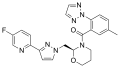
Vornorexant
An article about the drug Vornorexant
| Vornorexant | |
|---|---|
|
|

Vornorexant is a medication that acts as a dual orexin receptor antagonist. It is primarily investigated for its potential use in the treatment of insomnia and other sleep disorders.
Mechanism of Action[edit]
Vornorexant works by selectively blocking the action of orexin neuropeptides. Orexins, also known as hypocretins, are neuropeptides that regulate arousal, wakefulness, and appetite. By inhibiting the binding of orexins to their receptors, Vornorexant promotes sleep by reducing wakefulness.
Pharmacokinetics[edit]
The pharmacokinetic profile of Vornorexant includes its absorption, distribution, metabolism, and excretion. After oral administration, Vornorexant is absorbed into the bloodstream and distributed throughout the body. It is metabolized primarily in the liver and excreted via the kidneys.
Clinical Trials[edit]
Vornorexant has undergone several clinical trials to evaluate its efficacy and safety in treating insomnia. These trials assess various parameters such as sleep onset latency, total sleep time, and sleep quality.
Side Effects[edit]
Common side effects of Vornorexant may include drowsiness, headache, and dizziness. As with any medication, it is important to monitor for adverse effects and consult a healthcare provider if they occur.
Potential Uses[edit]
While primarily studied for insomnia, Vornorexant may have potential applications in other conditions related to sleep disturbances, such as narcolepsy and shift work sleep disorder.
Related pages[edit]
-
 Vornorexant

Medical Disclaimer: WikiMD is for informational purposes only and is not a substitute for professional medical advice. Content may be inaccurate or outdated and should not be used for diagnosis or treatment. Always consult your healthcare provider for medical decisions. Verify information with trusted sources such as CDC.gov and NIH.gov. By using this site, you agree that WikiMD is not liable for any outcomes related to its content. See full disclaimer.
Credits:Most images are courtesy of Wikimedia commons, and templates, categories Wikipedia, licensed under CC BY SA or similar.
Translate page: - East Asian
中文,
日本,
한국어,
South Asian
हिन्दी,
தமிழ்,
తెలుగు,
Urdu,
ಕನ್ನಡ,
Southeast Asian
Indonesian,
Vietnamese,
Thai,
မြန်မာဘာသာ,
বাংলা
European
español,
Deutsch,
français,
Greek,
português do Brasil,
polski,
română,
русский,
Nederlands,
norsk,
svenska,
suomi,
Italian
Middle Eastern & African
عربى,
Turkish,
Persian,
Hebrew,
Afrikaans,
isiZulu,
Kiswahili,
Other
Bulgarian,
Hungarian,
Czech,
Swedish,
മലയാളം,
मराठी,
ਪੰਜਾਬੀ,
ગુજરાતી,
Portuguese,
Ukrainian

