Volva (mycology)
Volva (mycology) is a distinctive structure found at the base of certain types of mushrooms, particularly those belonging to the genus Amanita, among others. The volva is a remnant of the universal veil (or peridium) that encloses the mushroom during its early developmental stages. As the mushroom grows, the veil ruptures, leaving behind various structures including the volva at the base, and sometimes patches on the cap or a ring around the stalk. The presence and characteristics of the volva are important diagnostic features in mushroom identification and mycology.
Structure and Function[edit]
The volva is typically a cup- or sack-like structure at the base of the mushroom stem. It can vary greatly in appearance, from a loose, membranous layer to a thick, warty, or scaly structure. The primary function of the volva, along with the rest of the universal veil, is to protect the developing spore-producing structures of the mushroom, known as the gills or pores, during the early stages of growth. As the mushroom matures and the stem elongates, the veil breaks, exposing the gills or pores and leaving the volva at the base.
Identification[edit]
In the field of mycology, the presence of a volva is a critical feature for identifying certain mushrooms, especially those within the Amanita genus, which includes both edible and highly toxic species. The volva, along with other features such as cap color, presence of a ring, and spore print color, are used to differentiate between species. For example, the deadly Amanita phalloides (Death Cap) and the edible Amanita caesarea (Caesar's Mushroom) can be distinguished by closely examining these features.
Toxicology[edit]
The volva is particularly noteworthy in the study of toxic mushrooms. Several of the most poisonous mushrooms, including the Death Cap (Amanita phalloides) and the Destroying Angel (Amanita virosa), have prominent volvas. These mushrooms contain potent toxins that can cause severe illness or death if ingested. Identification of the volva and other mushroom parts is crucial for foragers to avoid accidental poisoning.
Ecological Role[edit]
Mushrooms with a volva play various roles in their ecosystems. They are primarily saprotrophic, decomposing dead organic matter, but some species form symbiotic relationships with plants, known as mycorrhizae. These relationships are vital for nutrient exchange between the soil and plant roots, contributing to the health of ecosystems.

Volva (mycology)[edit]
-
 Amanita caesarea
 -
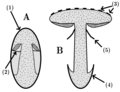 Basidioma agaric veils


Ad. Transform your life with W8MD's
GLP-1 weight loss injections special from $29.99 with insurance
|
WikiMD Medical Encyclopedia |
Medical Disclaimer: WikiMD is for informational purposes only and is not a substitute for professional medical advice. Content may be inaccurate or outdated and should not be used for diagnosis or treatment. Always consult your healthcare provider for medical decisions. Verify information with trusted sources such as CDC.gov and NIH.gov. By using this site, you agree that WikiMD is not liable for any outcomes related to its content. See full disclaimer.
Credits:Most images are courtesy of Wikimedia commons, and templates, categories Wikipedia, licensed under CC BY SA or similar.
Translate this page: - East Asian
中文,
日本,
한국어,
South Asian
हिन्दी,
தமிழ்,
తెలుగు,
Urdu,
ಕನ್ನಡ,
Southeast Asian
Indonesian,
Vietnamese,
Thai,
မြန်မာဘာသာ,
বাংলা
European
español,
Deutsch,
français,
Greek,
português do Brasil,
polski,
română,
русский,
Nederlands,
norsk,
svenska,
suomi,
Italian
Middle Eastern & African
عربى,
Turkish,
Persian,
Hebrew,
Afrikaans,
isiZulu,
Kiswahili,
Other
Bulgarian,
Hungarian,
Czech,
Swedish,
മലയാളം,
मराठी,
ਪੰਜਾਬੀ,
ગુજરાતી,
Portuguese,
Ukrainian
