Viburnum opulus
Viburnum opulus (also known as guelder-rose, water elder, cramp bark, snowball tree and European cranberrybush) is a species of flowering plant in the family Adoxaceae. It is native to Europe, northern Africa, and central Asia.
Description[edit]
Viburnum opulus is a deciduous shrub growing to 4–5 m (13–16 ft) tall. The leaves are opposite, three-lobed, 5–10 cm (2–4 in) long and broad, with a rounded base and coarsely serrated margins; they are superficially similar to the leaves of some maples, most easily distinguished by their somewhat wrinkled surface with impressed leaf venation. The leaf buds are green, with valvate bud scales.
Distribution and habitat[edit]
Viburnum opulus is widely distributed throughout Europe, Asia and North Africa. It is a common component of the Coppice woods, Hedgerows and Scrublands. It prefers moist soil and can grow in light woodland or at the edge of forests.
Uses[edit]
The fruit is edible in small quantities, with a very acidic taste; it can be used to make jelly. It is however very mildly toxic, and may cause vomiting or diarrhea if eaten in large amounts. The term "cramp bark" is related to the properties of the bark's ability to reduce smooth muscle tightness. It is called "cramp bark" as relieving this type of muscle tightness is often associated with relieving women's menstrual (period) cramps.
Cultivation[edit]
Viburnum opulus is grown as an ornamental plant for its flowers and berries, growing best on moist, moderately alkaline soils, though tolerating most soil types well. Several cultivars have been selected, including 'Roseum' (syn. 'Sterile', 'Snowball'), in which all the flowers are only of the larger sterile type, with globular flower heads.
See also[edit]

This flora-related article is a stub. You can help WikiMD by expanding it.
-
 Viburnum opulus
 -
 Snowball flowers
 -
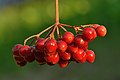 Viburnum opulus fruits
 -
 Flag of the President of Ukraine

.jpg)


Advertise on WikiMD — 81,000+ full articles, ~900,000 total pages, ~250 million page views. Global reach, limited time promotional rates from $1/page/day. Learn more · View stats

Translate page: - East Asian
中文,
日本,
한국어,
South Asian
हिन्दी,
தமிழ்,
తెలుగు,
Urdu,
ಕನ್ನಡ,
Southeast Asian
Indonesian,
Vietnamese,
Thai,
မြန်မာဘာသာ,
বাংলা
European
español,
Deutsch,
français,
Greek,
português do Brasil,
polski,
română,
русский,
Nederlands,
norsk,
svenska,
suomi,
Italian
Middle Eastern & African
عربى,
Turkish,
Persian,
Hebrew,
Afrikaans,
isiZulu,
Kiswahili,
Other
Bulgarian,
Hungarian,
Czech,
Swedish,
മലയാളം,
मराठी,
ਪੰਜਾਬੀ,
ગુજરાતી,
Portuguese,
Ukrainian
About WikiMD • Contact • Disclaimer • Privacy • Copyright • Site statistics
Some content and images may originate from Wikimedia Commons or Wikipedia and remain subject to their stated licenses. Unless otherwise noted, eligible WikiMD content is available under CC BY-SA 4.0.
WikiMD Wellnesspedia — Free health & wellness information for patients, students, and health professionals.

