Vaccinium
Genus of flowering plants in the heath family
Vaccinium is a genus of shrubs in the Ericaceae family, which includes a variety of species known for their edible fruits. These plants are commonly found in the Northern Hemisphere, particularly in North America and Eurasia.
Description[edit]
Vaccinium species are typically small shrubs, ranging from 10 cm to 4 m in height. The leaves can be evergreen or deciduous, depending on the species. The flowers are bell-shaped, with colors ranging from white to pink, and they produce berries that are often blue, red, or black.
Distribution and habitat[edit]
Vaccinium species are widely distributed across the Northern Hemisphere. They thrive in acidic soils and are commonly found in heathlands, forests, and mountainous regions. Some species are adapted to cold climates and can be found in the Arctic tundra.
Notable species[edit]
Several species within the Vaccinium genus are of economic importance due to their edible fruits:
- Vaccinium corymbosum - Known as the highbush blueberry, it is native to eastern North America and is widely cultivated for its sweet, edible berries.
- Vaccinium macrocarpon - Commonly known as the American cranberry, it is native to northeastern North America and is used in sauces, juices, and as a dried fruit.
- Vaccinium myrtillus - Known as the bilberry, it is found in Europe and produces small, dark blue berries.
- Vaccinium oxycoccos - Also known as the small cranberry, it is found in bogs across the Northern Hemisphere.

Cultivation and uses[edit]
Vaccinium species are cultivated for their fruit, which is consumed fresh, dried, or processed into products such as jams, juices, and sauces. The berries are rich in vitamins, antioxidants, and dietary fiber. In addition to their culinary uses, some species are used in traditional medicine.
Ecological importance[edit]
Vaccinium plants play a significant role in their ecosystems. They provide food for a variety of wildlife, including birds and mammals. The flowers are pollinated by insects, particularly bees, which are attracted to their nectar.
Related pages[edit]
References[edit]
- Huxley, A., ed. (1992). New RHS Dictionary of Gardening. Macmillan.
- USDA, ARS, National Genetic Resources Program. Germplasm Resources Information Network - (GRIN) [Online Database].

-
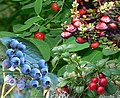 Vaccinium

Sponsored Health Resource

W8MD Weight Loss, Sleep & MedSpa
Looking for physician-supervised weight loss, semaglutide, tirzepatide, or GLP-1 receptor agonist options? W8MD helps eligible patients in New York City, Brooklyn, New Jersey, Connecticut, Pennsylvania, Delaware, and greater Philadelphia with medical weight loss, sleep medicine, and long-term maintenance support.
GLP-1 specials: Affordable GLP-1 injections NYC and Philadelphia starting from $29.99/week and up for semaglutide with insurance accepted for qualifying visits, and $45/week and up for tirzepatide with insurance accepted for qualifying visits. Self-pay options start from $59.99/week and up for semaglutide and $69.99/week and up for tirzepatide.
Medical weight loss NYC | Affordable GLP-1 injections NYC | Budget GLP-1 weight loss shots Philadelphia | New Jersey medical weight loss | NYC medical weight loss | Philadelphia medical weight loss | Sleep clinic NYC | W8MD's Philadelphia GLP-1 doctor | Weight loss prescriptions NYC
Book a W8MD appointment · View GLP-1 specials
Paid promotional message. Eligibility, pricing, insurance coverage, medication availability, and results vary. Medical evaluation required.

Medical Disclaimer: WikiMD is for informational purposes only and is not a substitute for professional medical advice. Content may be inaccurate or outdated and should not be used for diagnosis or treatment. Always consult your healthcare provider for medical decisions. Verify information with trusted sources such as CDC.gov and NIH.gov. By using this site, you agree that WikiMD is not liable for any outcomes related to its content. See full disclaimer.
Credits:Most images are courtesy of Wikimedia commons, and templates, categories Wikipedia, licensed under CC BY SA or similar.
Translate page: - East Asian
中文,
日本,
한국어,
South Asian
हिन्दी,
தமிழ்,
తెలుగు,
Urdu,
ಕನ್ನಡ,
Southeast Asian
Indonesian,
Vietnamese,
Thai,
မြန်မာဘာသာ,
বাংলা
European
español,
Deutsch,
français,
Greek,
português do Brasil,
polski,
română,
русский,
Nederlands,
norsk,
svenska,
suomi,
Italian
Middle Eastern & African
عربى,
Turkish,
Persian,
Hebrew,
Afrikaans,
isiZulu,
Kiswahili,
Other
Bulgarian,
Hungarian,
Czech,
Swedish,
മലയാളം,
मराठी,
ਪੰਜਾਬੀ,
ગુજરાતી,
Portuguese,
Ukrainian

