Urticating hair

Urticating hairs are a defense mechanism found in some arthropods, notably certain species of tarantulas and caterpillars. These specialized hairs can cause irritation and discomfort to potential predators or threats.
Description[edit]
Urticating hairs are barbed bristles that can be released from the body of the animal. In tarantulas, these hairs are typically found on the abdomen and can be flicked into the air using the hind legs. The hairs are designed to irritate the skin or mucous membranes of predators, providing a means of defense.

Types[edit]
There are several types of urticating hairs, classified based on their structure and function. In tarantulas, these are often categorized into types I through IV, with each type having a different shape and method of causing irritation.
Effects on Humans[edit]
Contact with urticating hairs can cause a range of symptoms in humans, from mild itching and redness to more severe allergic reactions. The severity of the reaction depends on the type of hair and the sensitivity of the individual.

Examples in Nature[edit]
Tarantulas[edit]
Many species of tarantulas, such as the Brachypelma smithi, possess urticating hairs. These spiders use the hairs as a primary defense mechanism against predators.

Caterpillars[edit]
Certain caterpillars, like those of the Euproctis chrysorrhoea (brown-tail moth), have urticating hairs that can cause skin rashes upon contact.

Related Pages[edit]
References[edit]
- Marshall, S. D., & Uetz, G. W. (1990). The function of urticating hairs in the tarantula Grammostola rosea. Journal of Arachnology, 18(2), 143-150.
- Roth, V. D. (1993). Urticating hairs in New World tarantulas. American Arachnology, 47, 1-4.
-
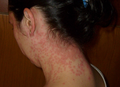 Euproctis Chrysorrhoea skin rash


Medical Disclaimer: WikiMD is for informational purposes only and is not a substitute for professional medical advice. Content may be inaccurate or outdated and should not be used for diagnosis or treatment. Always consult your healthcare provider for medical decisions. Verify information with trusted sources such as CDC.gov and NIH.gov. By using this site, you agree that WikiMD is not liable for any outcomes related to its content. See full disclaimer.
Credits:Most images are courtesy of Wikimedia commons, and templates, categories Wikipedia, licensed under CC BY SA or similar.
Translate page: - East Asian
中文,
日本,
한국어,
South Asian
हिन्दी,
தமிழ்,
తెలుగు,
Urdu,
ಕನ್ನಡ,
Southeast Asian
Indonesian,
Vietnamese,
Thai,
မြန်မာဘာသာ,
বাংলা
European
español,
Deutsch,
français,
Greek,
português do Brasil,
polski,
română,
русский,
Nederlands,
norsk,
svenska,
suomi,
Italian
Middle Eastern & African
عربى,
Turkish,
Persian,
Hebrew,
Afrikaans,
isiZulu,
Kiswahili,
Other
Bulgarian,
Hungarian,
Czech,
Swedish,
മലയാളം,
मराठी,
ਪੰਜਾਬੀ,
ગુજરાતી,
Portuguese,
Ukrainian

