Uroporphyrinogen III synthase
-
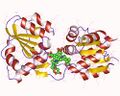 Uroporphyrinogen III synthase structure
 -
 Crystal structure of Uroporphyrinogen III synthase
 -
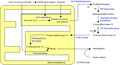 Heme synthesis pathway


Uroporphyrinogen III Synthase[edit]
Uroporphyrinogen III synthase is an enzyme that plays a crucial role in the biosynthesis of heme and chlorophyll. It catalyzes the conversion of hydroxymethylbilane to uroporphyrinogen III, a key intermediate in the pathway leading to the production of these essential biological pigments.
Function[edit]
Uroporphyrinogen III synthase is responsible for the cyclization and rearrangement of hydroxymethylbilane, a linear tetrapyrrole, into uroporphyrinogen III, a cyclic tetrapyrrole. This reaction is a critical step in the porphyrin biosynthesis pathway, which ultimately leads to the formation of heme and chlorophyll. The enzyme ensures the correct asymmetric arrangement of the pyrrole rings, which is essential for the biological function of the final products.
Mechanism[edit]
The enzyme operates by facilitating the closure of the linear tetrapyrrole chain into a macrocyclic structure. This involves the formation of a covalent bond between the terminal pyrrole rings, followed by a rearrangement that results in the inversion of one of the pyrrole rings. This inversion is crucial for the production of uroporphyrinogen III rather than the symmetric uroporphyrinogen I, which is not used in heme biosynthesis.
Clinical Significance[edit]
Deficiency or malfunction of uroporphyrinogen III synthase can lead to a group of disorders known as porphyrias. One such disorder is congenital erythropoietic porphyria (CEP), also known as Gunther's disease. CEP is characterized by the accumulation of porphyrins in the body, leading to symptoms such as photosensitivity, hemolytic anemia, and red-colored urine. The condition arises due to the accumulation of uroporphyrinogen I, which is formed when the enzyme is deficient or inactive.
Related Enzymes[edit]
Uroporphyrinogen III synthase is part of a larger family of enzymes involved in porphyrin metabolism. Other key enzymes in this pathway include:
- Porphobilinogen deaminase
- Uroporphyrinogen decarboxylase
- Coproporphyrinogen oxidase
- Protoporphyrinogen oxidase
Each of these enzymes plays a specific role in the stepwise conversion of simple precursors into complex porphyrin structures.
Related Pages[edit]
| Enzymes | ||||||||||
|---|---|---|---|---|---|---|---|---|---|---|
|

Medical Disclaimer: WikiMD is for informational purposes only and is not a substitute for professional medical advice. Content may be inaccurate or outdated and should not be used for diagnosis or treatment. Always consult your healthcare provider for medical decisions. Verify information with trusted sources such as CDC.gov and NIH.gov. By using this site, you agree that WikiMD is not liable for any outcomes related to its content. See full disclaimer.
Credits:Most images are courtesy of Wikimedia commons, and templates, categories Wikipedia, licensed under CC BY SA or similar.
Translate page: - East Asian
中文,
日本,
한국어,
South Asian
हिन्दी,
தமிழ்,
తెలుగు,
Urdu,
ಕನ್ನಡ,
Southeast Asian
Indonesian,
Vietnamese,
Thai,
မြန်မာဘာသာ,
বাংলা
European
español,
Deutsch,
français,
Greek,
português do Brasil,
polski,
română,
русский,
Nederlands,
norsk,
svenska,
suomi,
Italian
Middle Eastern & African
عربى,
Turkish,
Persian,
Hebrew,
Afrikaans,
isiZulu,
Kiswahili,
Other
Bulgarian,
Hungarian,
Czech,
Swedish,
മലയാളം,
मराठी,
ਪੰਜਾਬੀ,
ગુજરાતી,
Portuguese,
Ukrainian

