Typographical error
Typographical Error[edit]
A typographical error, often shortened to typo, is a mistake made in the typing process of printed material. This can occur due to mechanical failure or slip of the hand or finger, but is usually the result of human error. Typographical errors are common in both digital and print media and can range from minor spelling mistakes to significant errors that alter the meaning of the text.
History[edit]
The concept of typographical errors dates back to the early days of printing. In the medieval period, scribes would often make errors while copying texts by hand. With the invention of the printing press by Johannes Gutenberg in the 15th century, the potential for typographical errors increased as texts were reproduced more rapidly.
One of the most famous historical typographical errors is found in the "Wicked Bible" of 1631, where the word "not" was omitted from the commandment "Thou shalt not commit adultery," leading to the text "Thou shalt commit adultery."

Types of Typographical Errors[edit]
Typographical errors can be categorized into several types:
- Misspellings: Incorrect spelling of words, often due to transposition of letters or omission of characters.
- Punctuation errors: Misplacement or absence of punctuation marks.
- Formatting errors: Incorrect use of fonts, sizes, or styles.
- Grammatical errors: Mistakes in grammar that may arise from typographical errors.
Impact[edit]
Typographical errors can have varying impacts depending on the context. In casual communication, such as emails or text messages, typos are often overlooked. However, in professional or academic settings, they can undermine the credibility of the work. In some cases, typographical errors can lead to significant misunderstandings or financial losses.
Prevention and Correction[edit]
To prevent typographical errors, many writers and editors use spell checkers and grammar checkers. Proofreading is also a critical step in the editing process to catch errors that automated tools might miss. In digital media, errors can often be corrected quickly, but in print media, they may require reprinting, which can be costly.
Notable Examples[edit]
- The "Judas Bible" is another example where a typographical error led to a significant alteration in meaning. In this edition, "Judas" was printed instead of "Jesus" in a passage, leading to confusion.

Related Pages[edit]
-
Titivillus, the demon of typos
-
Example of a spelling correction
-
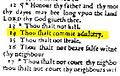 Marked page from the Wicked Bible
 -
 Page from the Judas Bible
Ad. Transform your life with W8MD's Budget GLP-1 injections from $75


W8MD offers a medical weight loss program to lose weight in Philadelphia. Our physician-supervised medical weight loss provides:
- Weight loss injections in NYC (generic and brand names):
- Zepbound / Mounjaro, Wegovy / Ozempic, Saxenda
- Most insurances accepted or discounted self-pay rates. We will obtain insurance prior authorizations if needed.
- Generic GLP1 weight loss injections from $75 for the starting dose.
- Also offer prescription weight loss medications including Phentermine, Qsymia, Diethylpropion, Contrave etc.
NYC weight loss doctor appointmentsNYC weight loss doctor appointments
Start your NYC weight loss journey today at our NYC medical weight loss and Philadelphia medical weight loss clinics.
- Call 718-946-5500 to lose weight in NYC or for medical weight loss in Philadelphia 215-676-2334.
- Tags:NYC medical weight loss, Philadelphia lose weight Zepbound NYC, Budget GLP1 weight loss injections, Wegovy Philadelphia, Wegovy NYC, Philadelphia medical weight loss, Brookly weight loss and Wegovy NYC


|
WikiMD's Wellness Encyclopedia |
| Let Food Be Thy Medicine Medicine Thy Food - Hippocrates |
Medical Disclaimer: WikiMD is not a substitute for professional medical advice. The information on WikiMD is provided as an information resource only, may be incorrect, outdated or misleading, and is not to be used or relied on for any diagnostic or treatment purposes. Please consult your health care provider before making any healthcare decisions or for guidance about a specific medical condition. WikiMD expressly disclaims responsibility, and shall have no liability, for any damages, loss, injury, or liability whatsoever suffered as a result of your reliance on the information contained in this site. By visiting this site you agree to the foregoing terms and conditions, which may from time to time be changed or supplemented by WikiMD. If you do not agree to the foregoing terms and conditions, you should not enter or use this site. See full disclaimer.
Credits:Most images are courtesy of Wikimedia commons, and templates, categories Wikipedia, licensed under CC BY SA or similar.
Translate this page: - East Asian
中文,
日本,
한국어,
South Asian
हिन्दी,
தமிழ்,
తెలుగు,
Urdu,
ಕನ್ನಡ,
Southeast Asian
Indonesian,
Vietnamese,
Thai,
မြန်မာဘာသာ,
বাংলা
European
español,
Deutsch,
français,
Greek,
português do Brasil,
polski,
română,
русский,
Nederlands,
norsk,
svenska,
suomi,
Italian
Middle Eastern & African
عربى,
Turkish,
Persian,
Hebrew,
Afrikaans,
isiZulu,
Kiswahili,
Other
Bulgarian,
Hungarian,
Czech,
Swedish,
മലയാളം,
मराठी,
ਪੰਜਾਬੀ,
ગુજરાતી,
Portuguese,
Ukrainian


